
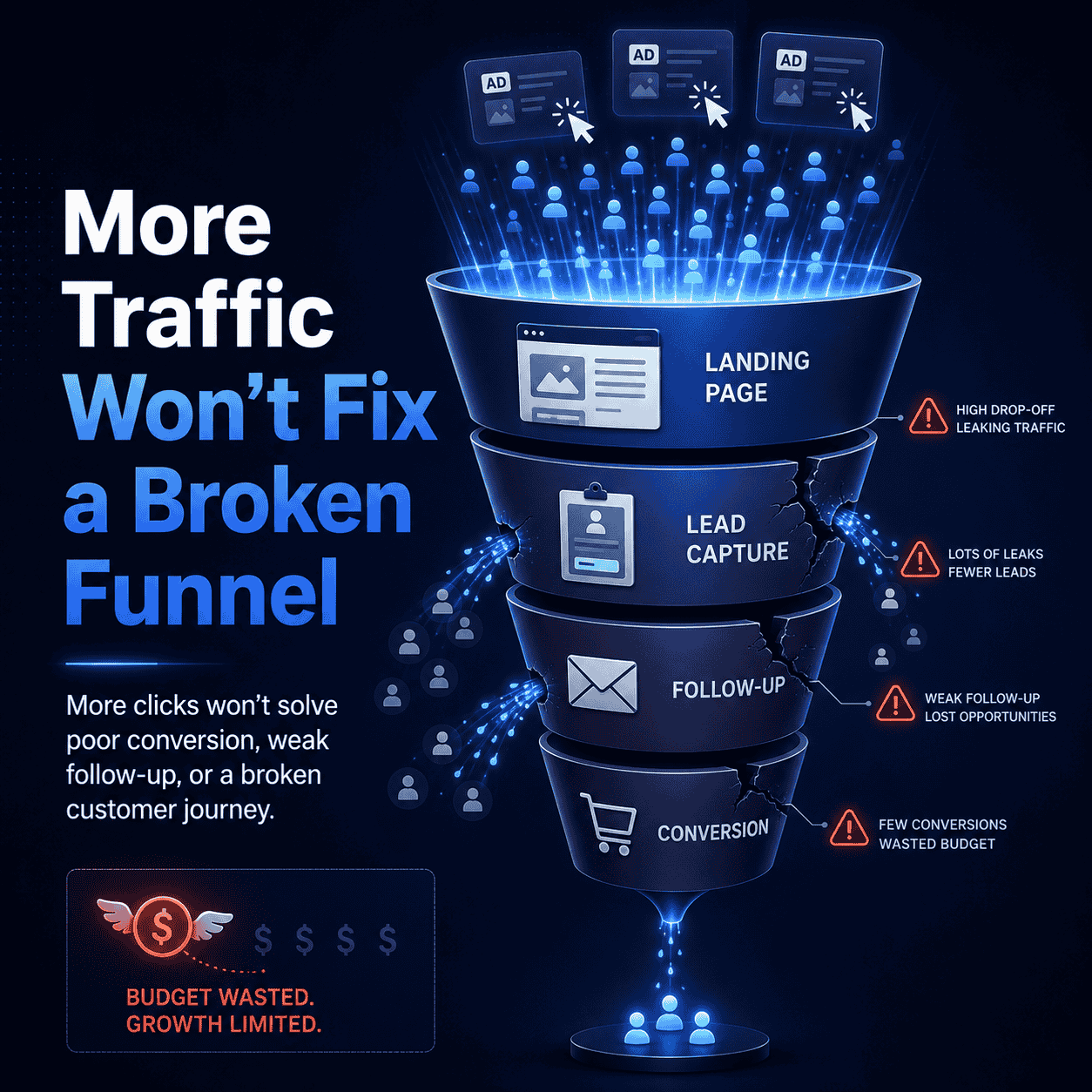
- More traffic only helps when the funnel can convert, follow up with and retain the people entering it.
- A broken funnel often hides behind normal-looking activity such as clicks, leads, carts, form views and email signups.
- The biggest leaks usually come from unclear positioning, ad-to-page mismatch, weak trust signals, missing follow-up, slow response time and too much friction.
- Before increasing ad spend, businesses should audit where visitors drop off and whether existing traffic is already being used well.
- A stronger funnel makes every visitor more valuable before the business pays for more traffic.
More traffic feels like the obvious answer.
If sales are slow, get more visitors. If leads are low, spend more on ads. If revenue is flat, launch another campaign. If the website is quiet, publish more content. If the pipeline feels thin, push harder at the top.
That instinct is understandable.
Traffic is visible. It is measurable. It gives the business a sense of motion. More sessions, more clicks, more impressions, more form views, more people entering the system.
But traffic is not the same as growth.
If the funnel underneath the traffic is broken, more visitors will not fix the business. It will only expose the leak faster.
A weak funnel turns paid traffic into expensive noise. It turns interested visitors into anonymous exits. It turns leads into forgotten names in a spreadsheet. It turns abandoned carts into missed revenue. It turns first-time customers into one-time transactions instead of repeat buyers.
For many businesses, the real question is not:
“How do we get more people to the website?”
The better question is:
“What happens to the people who already arrive?”
That question is uncomfortable because it forces the business to look beyond traffic metrics and examine the entire customer journey.
But it is also where better growth usually begins.
Traffic Is Not the Bottleneck If the Funnel Cannot Convert
A business can have a traffic problem.
Some companies genuinely do not have enough people discovering them. Their content is invisible. Their ads are underfunded. Their brand has no reach. Their website has no meaningful search presence. Their audience is too small to produce reliable demand.
In that case, traffic matters.
But many businesses are not dealing with a pure traffic problem.
They are dealing with a conversion problem, a follow-up problem, a trust problem, a positioning problem, or a customer journey problem.
Those are different issues.
If people visit the site but do not understand the offer, more traffic will not solve it.
If people click the ad but leave the landing page immediately, more traffic will not solve it.
If people submit forms but never receive a timely follow-up, more traffic will not solve it.
If people add products to cart but never return, more traffic will not solve it.
If people buy once and never hear from the brand again, more traffic will not solve it.
At that point, buying more traffic is like pouring water into a cracked bucket.
The business may feel busy.
But the system is still leaking.
The Most Expensive Funnel Problems Are Usually Quiet
Broken funnels do not always look dramatic.
Sometimes the website still gets visitors. The ads still get clicks. The email list still grows. The CRM still receives leads. The sales team still has conversations. The Shopify store still gets carts. The dashboard still shows activity.
That is what makes funnel problems dangerous.
They can hide inside normal-looking activity.
The business sees motion and assumes the system is working. But under the surface, potential revenue is slipping away at every stage.
A visitor lands on the homepage but cannot tell what the business actually does.
A prospect clicks an ad but the landing page says something different from the ad.
A lead downloads a guide but receives no useful follow-up.
A customer starts checkout but gets surprised by shipping costs.
A buyer makes one purchase but never receives a reason to come back.
A sales-qualified lead waits two days for a reply and chooses a competitor.
None of these problems feels catastrophic in isolation.
Together, they create a broken funnel.
A Simple Example: Why More Traffic Can Make the Problem Worse
Imagine a business gets 10,000 website visitors per month.
Out of those visitors:
- 2% become leads.
- 10% of leads become customers.
- The average customer is worth $200.
That means:
10,000 visitors produce 200 leads. 200 leads produce 20 customers. 20 customers produce $4,000 in revenue.
Now imagine the business wants to grow.
The instinct is to double traffic.
So the business spends more on ads and gets 20,000 visitors.
If the funnel stays the same:
20,000 visitors produce 400 leads. 400 leads produce 40 customers. 40 customers produce $8,000 in revenue.
That looks like growth, but it required double the traffic.
Now imagine a different approach.
Instead of doubling traffic, the business fixes the funnel.
The website becomes clearer. The landing page matches the ad better. The lead magnet is more relevant. The follow-up sequence improves. The sales response time gets faster. The checkout friction is reduced.
Now the same 10,000 visitors convert at:
- 3% lead conversion instead of 2%.
- 15% lead-to-customer conversion instead of 10%.
That produces:
10,000 visitors create 300 leads. 300 leads create 45 customers. 45 customers produce $9,000 in revenue.
The business generated more revenue from the same traffic.
That is the power of fixing the funnel.
Traffic scales what already exists.
If the funnel is weak, traffic scales waste.
If the funnel is strong, traffic scales revenue.
The Funnel Is Not One Page. It Is the Whole Journey.
Many businesses think of the funnel as a landing page.
That is too narrow.
The funnel includes every step between awareness and revenue.
It includes:
- The ad or content that creates attention
- The promise that gets the click
- The landing page experience
- The offer
- The form or checkout process
- The email follow-up
- The sales response
- The CRM organization
- The customer onboarding
- The post-purchase experience
- The repeat purchase or retention path
A funnel is not a diagram on a slide.
It is what the customer actually experiences.
That distinction matters.
A business may think it has a funnel because it has ads, a website, a form, and an email tool.
But if those pieces do not work together, it does not have a funnel.
It has disconnected parts.
A real funnel creates continuity.
The ad promise matches the landing page. The landing page leads to a clear next step. The lead receives timely follow-up. The follow-up answers the next logical objection. The sales process knows what the person already did. The customer receives a clear onboarding experience. The business has a plan to keep the relationship alive.
That is a funnel.
Not more pages.
More continuity.
The First Leak: Unclear Positioning
The funnel often breaks before the visitor even thinks about buying.
It breaks when the visitor cannot answer three questions quickly:
What is this? Who is it for? Why should I care?
Many websites fail here.
They use broad, polished language that sounds professional but says very little.
“Helping businesses unlock growth through innovative solutions.”
That may sound acceptable in a boardroom, but it does not help a visitor make a decision.
A stronger message is specific.
“We help local service businesses turn missed calls and website inquiries into booked appointments.”
That tells the visitor what the business does, who it helps, and what outcome it supports.
Positioning matters because confused visitors do not convert.
They leave.
And when they leave, the business often blames traffic quality.
Sometimes the traffic was fine.
The message was not.
The Second Leak: Ad-to-Page Mismatch
Paid traffic is fragile.
When someone clicks an ad, they are following a promise.
If the landing page does not continue that promise, trust drops immediately.
For example, an ad says:
“See how small businesses can recover abandoned carts.”
But the landing page is a generic homepage with no mention of abandoned carts.
That creates friction.
The visitor has to work too hard to connect the ad to the page. Most people will not do that work. They will leave.
This is one of the most common paid traffic mistakes.
The ad is specific.
The landing page is generic.
The campaign pays for intent, then sends that intent into a page that dilutes it.
A strong funnel keeps the scent.
If the ad talks about a specific problem, the landing page should address that problem immediately.
If the ad targets ecommerce sellers, the page should speak to ecommerce sellers.
If the ad offers a guide, the page should make the guide obvious.
If the ad promises a demo, the page should move the visitor toward the demo.
Every mismatch costs attention.
And attention is what the business already paid for.
The Third Leak: Weak Trust Signals
Most people do not convert just because they understand the offer.
They also need to trust it.
Trust is especially important for U.S. consumers and business buyers who are used to comparing options before making a decision.
They want to know:
Is this company real? Who else uses it? What happens after I submit the form? Can I cancel? Are there reviews? Is the pricing clear? Is support available? Does this look legitimate? Will I regret giving them my email or card information?
A funnel with weak trust signals may attract clicks but lose conversions.
Useful trust signals can include:
- Clear contact information
- Real customer reviews
- Case studies
- Testimonials
- Transparent pricing
- Security or privacy information
- Return or cancellation policy
- Recognizable customer segments
- Clear screenshots or product examples
- Founder or company background
- Helpful FAQ sections
Trust does not mean stuffing the page with badges and generic claims.
It means reducing the visitor’s risk.
A good funnel understands the questions people are already asking silently.
Then it answers them before they leave.
The Fourth Leak: No Follow-Up System
One of the biggest funnel leaks happens after the visitor shows interest.
The person signs up, downloads, clicks, adds to cart, starts checkout, or submits a form.
Then nothing meaningful happens.
This is where many businesses lose money.
A lead form without follow-up is not a funnel.
A cart without recovery is not a funnel.
An email list with no sequence is not a funnel.
A CRM full of contacts that nobody nurtures is not a funnel.
Follow-up is where interest becomes relationship.
That does not mean spamming people.
It means continuing the conversation in a way that matches their stage of awareness.
A new lead may need education. A cart abandoner may need reassurance. A demo request may need a fast human response. A first-time customer may need onboarding. An inactive customer may need a reason to return.
Without follow-up, the business keeps paying to create new first touches.
That is expensive.
The best businesses do not only acquire attention.
They retain and develop it.
The Fifth Leak: Slow Response Time
For service businesses, B2B companies, agencies, consultants, home services, clinics, and local businesses, speed matters.
A lead who fills out a form is often not waiting patiently for one company.
They may be contacting multiple providers.
If your business responds tomorrow and a competitor responds in five minutes, the competitor may win before your team even opens the email.
This is not just a sales problem.
It is a funnel problem.
If the funnel creates leads that are not handled quickly, the business is paying for opportunities it cannot capture.
A better system may include:
- Instant confirmation emails
- Calendar booking links
- Automated lead routing
- CRM task creation
- SMS alerts for high-intent forms
- Clear sales ownership
- Follow-up reminders
- Lead scoring
- Response-time tracking
Speed does not replace quality.
But slow follow-up can destroy intent.
The Sixth Leak: Too Much Friction
Even motivated buyers can abandon a process if it feels too hard.
Friction appears in many forms:
- Slow page load
- Long forms
- Confusing navigation
- Too many pop-ups
- Unclear pricing
- Surprise fees
- Weak mobile experience
- Required account creation
- Too many checkout steps
- No obvious next action
- Vague button copy
- Broken tracking or form errors
Every extra step asks the visitor to give more effort.
Some will.
Many will not.
This is especially true on mobile, where attention is short and distractions are constant.
A strong funnel does not force people to think harder than necessary.
It makes the next step obvious.
The Seventh Leak: No Measurement Beyond Traffic
A business cannot fix what it cannot see.
Many teams track traffic but not funnel health.
They know how many people visited the site, but not where people drop off.
They know how many leads came in, but not which leads became customers.
They know ad spend, but not lead quality.
They know sales, but not which funnel steps influenced those sales.
This creates bad decisions.
The team may blame the ad when the landing page is weak. They may blame the sales team when lead quality is poor. They may blame traffic volume when follow-up is inconsistent. They may blame the website when the offer is unclear.
A healthy funnel needs measurement at every stage.
Not endless dashboards.
Just enough visibility to know where the leak is.
Useful funnel metrics may include:
- Landing page conversion rate
- Lead capture rate
- Cost per qualified lead
- Form completion rate
- Cart abandonment rate
- Checkout completion rate
- Email open and click rates
- Lead response time
- Demo show-up rate
- Lead-to-customer rate
- First purchase to repeat purchase rate
- Customer lifetime value
More traffic is only a smart investment when the business understands what happens to that traffic.
The Diagnostic Question: Where Is the Drop-Off?
A business advisor would not start by asking how to get more traffic.
They would start by asking where the funnel breaks.
Is the business failing to attract attention?
That is a traffic problem.
Is the business attracting visitors who leave immediately?
That may be a message, page, or targeting problem.
Are visitors interested but not converting?
That may be an offer, trust, or friction problem.
Are leads coming in but not buying?
That may be a follow-up, sales, or lead quality problem.
Are customers buying once but not returning?
That may be an onboarding, retention, or customer experience problem.
Each problem requires a different fix.
This is why “we need more traffic” can be a dangerous conclusion.
It may be true.
But it should not be assumed.
A Practical Funnel Audit for Businesses
Before increasing the ad budget, run a funnel audit.
Start with the customer journey.
1. Review the Promise
Look at the ad, social post, email, or search result that brings people in.
Ask:
Is the promise clear? Is it specific? Is it believable? Does it match what the landing page delivers? Does it attract the right person or just cheap clicks?
A weak promise can create low-quality traffic.
A strong promise attracts the right visitor and sets up the rest of the funnel.
2. Review the Landing Page
Open the page on a phone.
Most visitors will not experience your funnel on a perfect desktop setup.
Ask:
Can a visitor understand the offer in five seconds? Is the next step obvious? Does the page load quickly? Does the message match the traffic source? Is there enough proof? Are the visuals clear? Is there unnecessary friction? Does the page feel trustworthy?
If the page fails on mobile, the funnel is leaking.
3. Review the Offer
A funnel cannot save an offer that people do not want.
Ask:
Is the value clear? Is the price justified? Is the outcome specific? Is the risk reduced? Is there urgency without manipulation? Is the offer different from competitors? Does the visitor understand why now?
Sometimes the funnel is not broken.
The offer is not strong enough.
4. Review the Capture Point
If the visitor is not ready to buy, is there another way to stay connected?
Examples:
- Email signup
- Free guide
- Demo request
- Quote request
- Quiz
- Consultation form
- Webinar registration
- Product reminder
- Abandoned cart capture
A funnel that only offers “buy now” may lose people who are interested but not ready.
A good capture point gives the business a second chance.
5. Review the Follow-Up
Ask what happens after the visitor converts into a lead or contact.
Is there an immediate confirmation? Is there a welcome sequence? Is there a sales task? Is there a reminder if the lead does not respond? Is there a cart recovery flow? Is there a nurture sequence? Is there segmentation based on behavior?
If the answer is no, the funnel is not finished.
It stops too early.
6. Review the Sales Handoff
For businesses with sales teams, the handoff is critical.
Ask:
Who owns the lead? How fast do they respond? What context do they receive? Is the lead qualified? Are there follow-up tasks? Is the outcome tracked? Do we know why leads are lost?
Many funnels look fine in marketing dashboards and fail during the handoff.
7. Review Retention
The funnel does not end at the first purchase.
Ask:
What happens after someone buys? Do they receive onboarding? Do they know how to get value? Are they invited to buy again? Are they segmented based on purchase behavior? Is there a win-back flow? Are reviews collected? Are referrals encouraged?
Acquiring a customer is expensive.
Keeping the relationship alive is often more profitable than constantly replacing customers with new ones.
When More Traffic Is the Right Move
This article is not an argument against traffic.
Traffic matters.
Ads matter. SEO matters. Content matters. Social distribution matters. Partnerships matter. Audience growth matters.
More traffic is the right move when the funnel is already converting at a healthy rate and the business has confidence in the economics.
If the business knows:
- The landing page converts
- Lead quality is strong
- Follow-up is consistent
- Sales response is fast
- Customer acquisition cost is sustainable
- Lifetime value supports the spend
- The team can handle more demand
Then scaling traffic makes sense.
But scaling traffic before fixing the funnel is risky.
It can make the business feel like it is growing while profitability gets worse.
What Businesses Should Fix First
The best place to start depends on the biggest leak.
But if a business does not know where to begin, use this order:
1. Clarify the Offer
Make sure visitors understand what is being sold, who it is for, and why it matters.
2. Match the Message
Make sure ads, emails, social posts, and landing pages tell the same story.
3. Reduce Friction
Make forms, checkout, navigation, and next steps easier.
4. Add Trust
Use proof, reviews, FAQs, policies, screenshots, case studies, or real examples.
5. Capture Interested Visitors
Give people a reason to join the list, request more information, or take a smaller step.
6. Build Follow-Up
Create welcome, nurture, cart recovery, lead response, and re-engagement flows.
7. Measure the Funnel
Track where people enter, where they drop off, and which actions lead to revenue.
This sequence is not glamorous.
But it works because it addresses the system instead of only increasing pressure at the top.
A Better Growth Mindset
The old growth mindset says:
“We need more leads.”
The better growth mindset asks:
“What are we doing with the leads we already have?”
The old growth mindset says:
“We need more website traffic.”
The better growth mindset asks:
“Why are current visitors leaving?”
The old growth mindset says:
“We need cheaper clicks.”
The better growth mindset asks:
“Are we converting the clicks we already buy?”
The old growth mindset says:
“We need a bigger audience.”
The better growth mindset asks:
“Are we building trust with the audience we already reached?”
That shift changes everything.
The business stops treating growth as a volume problem and starts treating it as a system problem.
The Executive Takeaway
More traffic can grow a business only when the funnel is ready for it.
If the message is unclear, more traffic creates more confusion.
If the landing page is weak, more traffic creates more exits.
If follow-up is missing, more traffic creates more forgotten leads.
If measurement is poor, more traffic creates more uncertainty.
If retention is weak, more traffic creates more one-time customers.
Traffic is fuel.
The funnel is the engine.
Pouring more fuel into a broken engine will not make the car run better.
Before spending more to bring people in, make sure the business knows what happens after they arrive.
Final Thoughts
More traffic is not a strategy by itself.
It is an amplifier.
It amplifies the strength of a good funnel and the weakness of a broken one.
A business with a clear message, strong offer, trustworthy landing page, simple conversion path, consistent follow-up, fast sales response, and reliable measurement can benefit from more traffic.
A business without those pieces may simply pay more to lose more people.
Before increasing ad spend, publishing more content, or chasing another traffic channel, examine the journey.
Where do people drop off? Where do they hesitate? Where do they lose trust? Where does follow-up stop? Where does the business lose visibility?
Fix those leaks first.
Because more traffic will not fix a broken funnel.
A better funnel will make every visitor more valuable.
Brevo can help small businesses capture leads, organize contacts, send email campaigns and build simple automation workflows after the click.
This article is for general educational purposes only. Marketing performance depends on industry, offer quality, audience, funnel design, pricing, customer behavior, tracking setup, and execution. Businesses should review their own data before increasing paid traffic budgets.