

- AI is changing Facebook Ads across creative production, campaign automation, reporting, video, voiceovers and optimization.
- Meta’s automation works best when advertisers provide strong creative angles, clean conversion tracking and landing pages that match the ad promise.
- AI tools can help marketers move faster, but they cannot fix a weak offer, poor data, confusing landing pages or compliance problems.
- Creative testing should focus on different buyer motivations, not just cosmetic design changes.
- The best workflow is AI-assisted, not AI-only: use AI for speed, then keep human review for strategy, brand control and final decisions.
Facebook Ads used to feel like a targeting puzzle.
Pick the right interests. Build the right lookalike. Split the right ad sets. Find the hidden audience. Scale the winner before performance drops.
That version of Facebook advertising is fading.
Meta’s ad system is becoming more automated, more AI-driven and more dependent on creative signals, conversion data and campaign learning. Manual targeting still matters in some cases, but it is no longer the only place where advertisers win.
The new Facebook Ads game is different.
AI now helps with audience expansion, ad variation, creative personalization, budget allocation, performance prediction, copywriting, video editing, reporting and campaign analysis.
But that does not mean marketers can simply press one button and let AI handle everything.
AI can help you move faster. It can help you produce more creative. It can help you see patterns sooner. It can help you test more ideas. It can help you reduce manual work.
But AI still needs strategy.
The marketers who win with Facebook Ads in 2026 will not be the ones who use the most AI tools. They will be the ones who use AI to improve the full advertising workflow: research, creative, testing, tracking, landing pages and optimization.
This guide breaks down how AI is being used in Facebook Ads, which tool categories matter most and how advertisers can build a smarter paid social workflow without losing brand control.
The Big Shift: AI Is Becoming the Operating System of Facebook Ads
Meta has been moving advertisers toward automation for years.
Advantage+ campaigns, Advantage+ creative, automated placements, audience expansion and machine-learning delivery are all part of the same direction: Meta wants the ad system to make more decisions in real time.
That changes the advertiser’s job.
The old job was to control every setting.
The new job is to feed the system better inputs.
Those inputs include:
- Better creative angles
- Better product information
- Better conversion tracking
- Better landing pages
- Better customer data
- Better testing structure
- Better brand review
- Better campaign goals
The algorithm can only optimize from what it can see.
If the creative is weak, AI has little to work with. If tracking is broken, AI learns from incomplete signals. If the landing page does not convert, AI cannot fix the funnel. If the offer is unclear, AI may find clicks but not buyers.
This is why Facebook Ads are becoming less about “hacking the targeting” and more about building a system that helps AI learn faster.
Where AI Fits in the Facebook Ads Workflow
AI can be useful across almost every part of the campaign process.
But not every tool solves the same problem.
A smart workflow separates AI tools into clear jobs:
1. Research the market 2. Generate creative ideas 3. Write and test ad copy 4. Produce static and video ads 5. Create voiceovers for video ads 6. Analyze competitor ads 7. Measure creative performance 8. Improve landing pages 9. Track conversions 10. Review and optimize campaigns
This matters because a marketer who only uses AI to generate more images may still fail if the offer is weak, the hook is unclear or the conversion tracking is poor.
The goal is not “more ads.”
The goal is more useful learning.
1. AI for Audience and Campaign Automation
The first layer of AI is inside Meta itself.
Meta’s Advantage+ tools can help automate parts of campaign setup, audience discovery, placements, creative adjustments and delivery optimization.
For many advertisers, this means the platform is doing more of the work that used to be handled manually.
Instead of tightly controlling every audience segment, advertisers often give Meta broader flexibility and let the system find people who are more likely to take action.
This can work well when the account has:
- Clear conversion events
- Enough data volume
- Strong creative variety
- A simple campaign structure
- A landing page that matches the ad promise
- A real business goal such as purchases, leads or booked calls
But automation is not magic.
If the inputs are poor, automated delivery can still produce poor results.
AI can optimize a campaign faster, but it cannot invent a better offer, repair a confusing website or make bad creative persuasive.
2. AI for Ad Creative Generation
Creative is one of the biggest areas where AI is changing Facebook Ads.
A few years ago, a marketer might create five static ads and test them slowly.
Now, AI tools can help generate dozens of variations: different backgrounds, headlines, layouts, product visuals, video hooks and ad formats.
This is useful because Facebook Ads performance often depends on creative freshness.
Audiences get tired of seeing the same ad. Competitors copy winning angles. Costs rise when creative fatigue hits.
AI creative tools can help teams produce more testable ideas faster.
Examples of tools in this category include:
- AdCreative.ai
- Creatopy
- Predis.ai
- Pencil
- Canva Magic Studio
- The Brief
- Marpipe for catalog-based creative
- Meta Advantage+ creative
These tools are not all the same.
Some focus on static ad images. Some focus on video ads. Some help with resizing and brand consistency. Some generate copy and visuals together. Some are better for e-commerce catalogs. Some are better for agencies that need many variations.
The key is to use AI creative tools to test different ideas, not just different designs.
A stronger creative test changes the message.
For example:
- “Save time” angle
- “Lower cost” angle
- “Before and after” angle
- “Customer proof” angle
- “Problem-solution” angle
- “Founder story” angle
- “Product demo” angle
- “Mistake to avoid” angle
- “Comparison” angle
- “Limited offer” angle
Changing the background color is not a real test.
Changing the reason someone should care is a real test.

3. AI for Ad Copy and Hook Writing
The first line of a Facebook ad still matters.
A weak hook can kill a strong product. A vague headline can waste a strong visual. A generic ad can disappear in the feed.
AI writing tools can help generate more hooks, headlines, primary text variations and callout lines.
Examples of tools marketers may use for copy and ideation include:
- ChatGPT
- Claude
- Jasper
- Copy.ai
- Anyword
- Notion AI
- Canva Magic Write
- Meta’s own text generation features
But AI copy should not be pasted directly into ads without editing.
The best workflow is:
Generate rough angles. Select the strongest hooks. Rewrite them in the brand’s voice. Remove generic wording. Make the promise specific. Check compliance. Test the best variations.
Bad AI ad copy sounds like this:
“Unlock your full potential with our innovative solution designed for modern businesses.”
That says almost nothing.
Better ad copy sounds like this:
“Still building reports by hand every Friday? Here’s a faster way to see which campaigns are actually making money.”
The second version is more specific. It names the pain. It sounds like a real problem.
AI can give you options, but the marketer still needs judgment.
4. AI for Video Ads and Short-Form Creative
Video is one of the most important formats for Facebook and Instagram advertising.
The problem is that video production can be slow.
You need a script, footage, captions, voiceover, pacing, editing, aspect ratios and multiple versions for different placements.
AI tools can help speed up that process.
Useful tool categories include:
- AI video editors
- AI script generators
- AI voiceover tools
- AI caption tools
- AI product video generators
- AI background and scene generators
- AI repurposing tools for turning long content into short clips
Examples include:
- CapCut
- Descript
- Runway
- Creatify
- Predis.ai
- AdCreative.ai
- Pencil
- ElevenLabs for voiceovers
- Canva video tools
For Facebook Ads, AI video is especially helpful when you need to create multiple versions of the same idea.
For example, one product demo can become:
- A 15-second Reels ad
- A 30-second Feed ad
- A 6-second hook test
- A voiceover version
- A captions-only version
- A founder-narrated version
- A UGC-style version
- A product close-up version
This gives Meta more creative signals to learn from.
But video still needs quality control.
AI can generate a polished-looking clip that makes the product look strange, misrepresents a feature or creates an unrealistic scene. Every AI-generated video should be reviewed before launch.
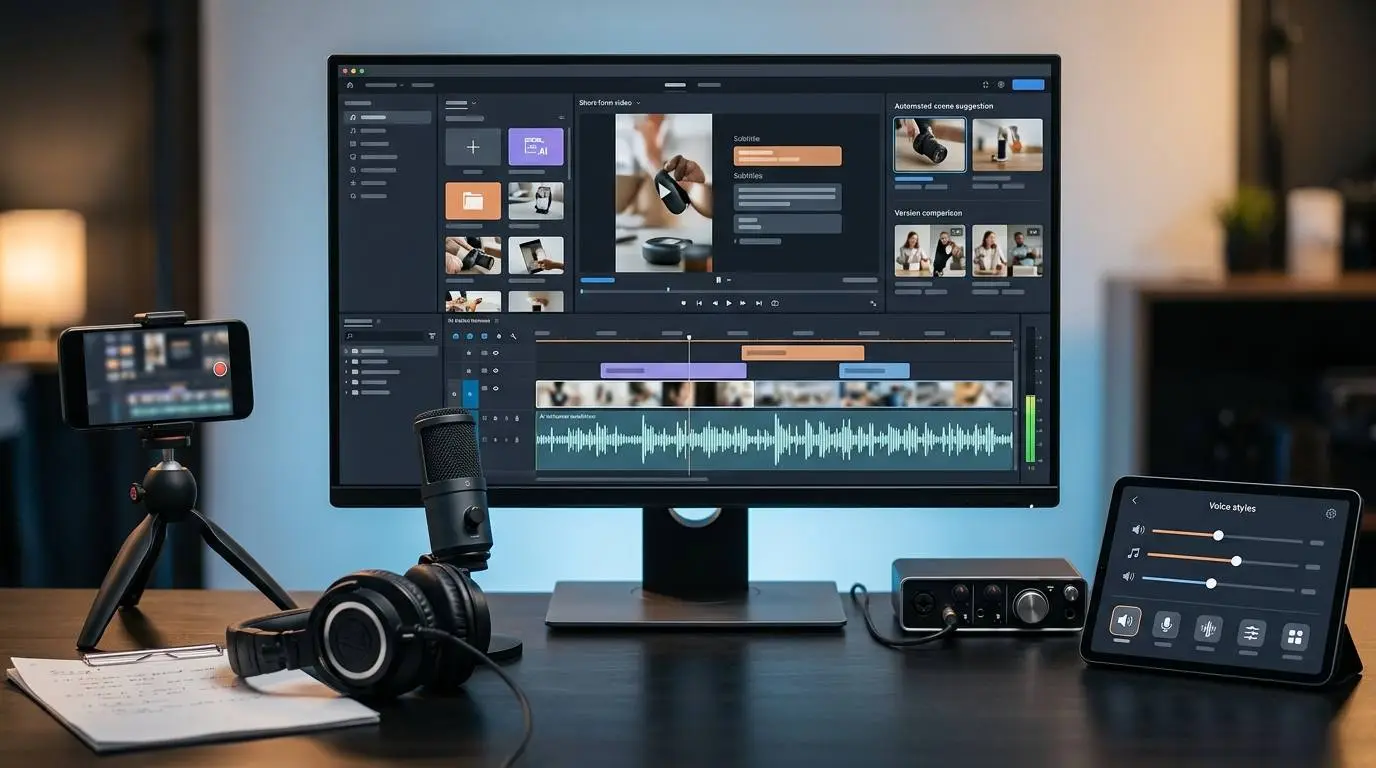
5. AI Voiceovers for Facebook Ads
Voice can change how an ad feels.
A product demo with no narration may feel flat. A tutorial with unclear audio may lose viewers. A short video with a strong voiceover can explain the value faster.
AI voiceover tools can help marketers create narration for:
- Product demo ads
- Explainer videos
- Course promotion ads
- App walkthroughs
- SaaS feature ads
- E-commerce product ads
- Short-form educational clips
- Retargeting videos
- Customer onboarding content
ElevenLabs is one example of an AI voice platform that creators and marketers may consider for voiceover production.
The advantage is speed. A marketer can write a script, generate narration, edit the pacing and test different voice styles without recording every line manually.
But AI voice should be used carefully.
Do not clone someone’s voice without permission. Do not create fake testimonials. Do not make viewers believe a real person said something they did not say. Do not use a voice in a way that violates commercial rights.
For normal ad production, the safest approach is to use licensed voices, write original scripts and review the final audio before publishing.
6. AI for Competitor Research and Ad Inspiration
Creative research is one of the most underrated parts of Facebook Ads.
Many advertisers start by asking:
“What should we make?”
A better question is:
“What patterns are already working in this market?”
AI can help organize ad inspiration, summarize competitor angles, identify repeated hooks and turn research into creative briefs.
Useful tools in this area include:
- Foreplay
- Motion
- MagicBrief
- Swipekit
- Meta Ads Library
- TikTok Creative Center
- Google Trends
- ChatGPT for summarizing patterns
The goal is not to copy competitors.
That is a bad strategy and can weaken your brand.
The goal is to study the market.
Look for:
- Common hooks
- Repeated objections
- Offer styles
- Visual patterns
- UGC formats
- Product demo structures
- Testimonial formats
- Before-and-after framing
- Problem-solution sequences
- Long-running ads that may indicate strength
Then build your own version from your own product, offer and brand voice.
Research should create direction, not duplication.
7. AI for Creative Analytics
Once ads are running, the next challenge is understanding why they work.
A campaign may show that one ad has the best cost per purchase. But the deeper question is:
Why did that creative win?
Was it the hook? The first frame? The product shot? The headline? The offer? The voiceover? The testimonial? The pacing? The landing page match?
Creative analytics tools can help marketers break down performance by message, format, hook, visual style and audience response.
Examples of tools and platforms that can support creative analysis include:
- Motion
- Marpipe
- Foreplay
- Triple Whale for e-commerce attribution
- Northbeam for attribution analysis
- Supermetrics for reporting
- Looker Studio dashboards
- Meta Ads reporting
- Google Analytics 4
This is where AI becomes more than a creative generator.
It becomes a learning assistant.
The best advertisers build a feedback loop:
Launch creative. Measure performance. Identify the winning pattern. Create the next batch. Test again.
Without that loop, AI just helps you create more noise.
8. AI for Landing Pages and Post-Click Experience
Facebook Ads do not end at the click.
A great ad can fail if the landing page is slow, confusing or disconnected from the promise in the ad.
AI landing page and conversion tools can help marketers:
- Draft landing page copy
- Build page variations
- Create product benefit sections
- Write FAQs
- Summarize customer objections
- Generate testimonial layouts
- Analyze heatmaps
- Improve form flow
- Test different headlines
Examples of tools in this area include:
- Unbounce
- Leadpages
- Webflow AI features
- Framer AI
- Instapage
- Hotjar
- Microsoft Clarity
- Optimizely
- VWO
- ChatGPT or Claude for landing page copy review
The landing page should continue the same promise as the ad.
If the ad says “create ad videos faster,” the page should show that immediately.
If the ad says “reduce manual reporting,” the page should prove that immediately.
If the ad says “save money on campaign management,” the page should explain the savings clearly.
AI can help create landing page variations, but human review is needed to make sure the page is accurate, compliant and believable.
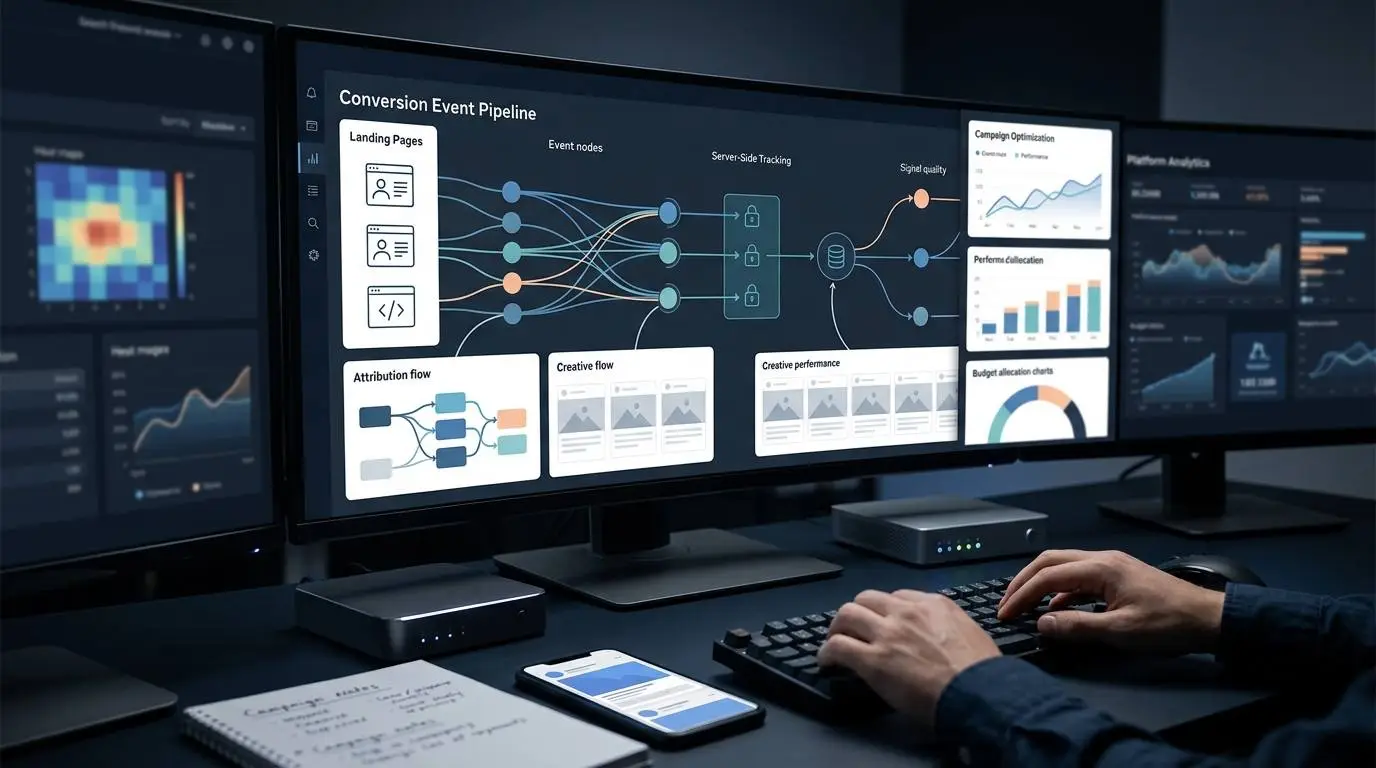
9. AI for Tracking, Reporting and Signal Quality
Facebook Ads performance depends heavily on signal quality.
If conversion tracking is incomplete, the algorithm may not learn correctly.
If leads are low quality, the campaign may optimize for form fills instead of real customers.
If purchase data is missing, the system may undervalue the best traffic.
AI and automation can help analyze performance, but the foundation still depends on accurate data.
Useful tool categories include:
- Server-side tracking
- Conversions API setup
- UTM management
- CRM feedback
- Marketing dashboards
- Attribution tools
- Data connectors
- Lead quality scoring
Examples include:
- Meta Pixel and Conversions API
- Google Tag Manager
- Stape
- Segment
- RedTrack
- Hyros
- Triple Whale
- Northbeam
- Supermetrics
- Databox
- Looker Studio
- Google Analytics 4
- HubSpot
- ActiveCampaign
This part may not feel as exciting as AI-generated creatives, but it is critical.
The algorithm learns from events.
If those events are wrong, incomplete or too shallow, AI can optimize toward the wrong outcome.
Better data does not guarantee better performance, but poor data almost always limits performance.
10. AI for Campaign Review and Decision-Making
One of the best uses of AI is campaign analysis.
A marketer can export campaign data, summarize performance and ask an AI assistant to identify patterns.
For example:
- Which creative angles had the lowest cost per result?
- Which ads had strong click-through rate but weak conversion rate?
- Which campaigns spent budget without enough learning?
- Which landing pages had the highest drop-off?
- Which audience or placement patterns are worth reviewing?
- Which hooks should be turned into the next creative batch?
AI can help organize the analysis, but it should not make final decisions without context.
A campaign may look weak in Ads Manager but still produce high-quality customers later. A lead campaign may look cheap but create poor sales outcomes. A video ad may have low clicks but strong retargeting value.
The marketer still needs business judgment.
AI is best used as a second analyst, not the final boss.
A Practical AI Stack for Facebook Ads
A small team does not need every tool.
A simple AI-assisted Facebook Ads stack could look like this:
Beginner Stack
Best for solo creators, small businesses and low-budget advertisers.
- ChatGPT or Claude for strategy, hooks and ad copy
- Canva for static creative
- CapCut for short video editing
- ElevenLabs for voiceover tests
- Meta Advantage+ creative for native variations
- Google Analytics 4 for basic performance review
Growth Stack
Best for brands spending consistently on paid social.
- Foreplay or Motion for creative research
- AdCreative.ai, Predis.ai or Creatopy for creative generation
- Canva or Figma for brand editing
- ElevenLabs for scalable voiceovers
- Stape or GTM server-side for better tracking
- Looker Studio, Supermetrics or Databox for reporting
E-Commerce Stack
Best for Shopify or product catalog advertisers.
- Marpipe for catalog creative
- Pencil or AdCreative.ai for product ad generation
- Foreplay for competitor research
- Triple Whale or Northbeam for attribution
- Klaviyo or HubSpot for customer follow-up
- Meta Conversions API for cleaner purchase signals
Agency Stack
Best for teams managing multiple clients.
- Foreplay or Motion for ad research and creative briefs
- Creatopy for production at scale
- AdCreative.ai or Pencil for AI ad variations
- Supermetrics for dashboard reporting
- Databox or Looker Studio for client reporting
- Notion AI or ChatGPT for documentation and campaign summaries
- ElevenLabs for voiceover drafts and video concepts
The right stack depends on your bottleneck.
If you lack ideas, start with research tools. If you lack creative volume, start with creative generation. If you lack video output, start with video and voice tools. If you lack trust in the data, start with tracking and reporting. If you lack conversions, fix the landing page before buying another creative tool.
What AI Cannot Fix
AI can make Facebook Ads faster, but it cannot fix every business problem.
AI cannot fix:
- A weak offer
- A confusing product
- Poor margins
- Bad customer service
- A slow website
- Misleading claims
- A broken checkout
- Low-quality leads
- Compliance problems
- A brand that looks untrustworthy
- A campaign with no clear objective
This is important.
Many advertisers blame the algorithm when the real problem is the funnel.
AI can help you test faster, but it will also reveal weaknesses faster.
If people click but do not buy, the issue may be the landing page. If people watch but do not click, the issue may be the offer. If people submit forms but never purchase, the issue may be lead quality. If people comment negatively, the issue may be trust or messaging.
AI is a multiplier.
It multiplies good strategy.
It can also multiply bad strategy.
How to Use AI Without Losing Brand Control
AI ad tools can create mistakes.
They may generate unrealistic product images, off-brand copy, inaccurate claims or visuals that do not match the real product. This is especially risky in categories such as health, finance, legal services, supplements, beauty, children’s products and regulated industries.
Before launching AI-assisted ads, review:
- Product accuracy
- Visual realism
- Claims and promises
- Brand tone
- Legal and platform compliance
- Voiceover rights
- Customer testimonial accuracy
- Image distortions
- Landing page consistency
- Disclosure requirements
AI should speed up production, not remove approval.
The best workflow is:
AI creates options. Humans review quality. Campaigns test performance. Data informs the next batch.
That keeps speed and control in balance.
The Future of Facebook Ads Is AI-Assisted, Not AI-Only
The future of Facebook Ads will not be about choosing between humans and AI.
It will be about dividing the work better.
AI can generate options. Humans choose direction. AI can analyze patterns. Humans understand business context. AI can produce variations. Humans protect trust. AI can optimize delivery. Humans decide the strategy.
That is the real advantage.
Advertisers who ignore AI may move too slowly. Advertisers who trust AI blindly may lose control.
The best marketers will use AI as an operating layer across the whole campaign process.
Research faster. Create faster. Test smarter. Measure better. Protect the brand. Improve the next campaign.
That is how AI becomes useful in Facebook Ads.
Not as a shortcut around marketing.
As a way to make good marketing move faster.
Final Thoughts
AI is changing Facebook Ads, but not in the way many people think.
It is not only about generating pretty images or writing quick captions.
It is changing how campaigns are planned, produced, tested, measured and optimized.
The biggest opportunity is not replacing the marketer.
The opportunity is building a better workflow.
A strong AI-powered Facebook Ads process starts with research, turns insights into creative angles, uses AI tools to produce more variations, tests those ideas in Meta, tracks real conversion quality and feeds the learning back into the next batch.
That is the new advantage.
The winners will not be the advertisers with the most tools.
They will be the advertisers with the clearest strategy, the cleanest data and the strongest creative learning loop.
EDITOR’S NOTE This article is for general educational purposes only. AI advertising tools, Meta Ads features and platform policies can change quickly. Always review current tool terms, Meta advertising rules and brand safety requirements before launching AI-assisted campaigns.
Editor’s note
This article is for general educational purposes only. AI advertising tools, Meta Ads features and platform policies can change quickly. Always review current tool terms, Meta advertising rules and brand safety requirements before launching AI-assisted campaigns.