

- Diagnose the obstacle before choosing a tone: administrative delay, dispute, cash constraint, habitual lateness, and serious deterioration need different responses.
- A useful customer commitment specifies the amount, payment date, payment event, responsible person, and any unresolved condition.
- Strategic clients may need a different communication path, but every exception still needs an owner, exposure ceiling, expiration date, and failure response.
- Automation helps with stable rules and visible account states; it becomes risky when disputes, payment plans, executive negotiations, or unapplied cash sit outside the system.
- Service suspension is a risk-control decision, not a punishment. Management should compare contractual rights, added exposure, customer credibility, and likely recovery outcomes.
The invoice is twelve days overdue.
It belongs to one of the agency’s largest clients—a company responsible for almost 18% of annual revenue. The account manager does not want finance to send another reminder because the client is considering a new project. Finance points out that the current balance is $64,000 and that two contractors have already been paid for the work.
The account manager says:
“They always pay. Let’s not create tension.”
The controller asks:
“Then what date are they paying?”
No one knows.
The client has not disputed the invoice. It has not promised a payment date. The account manager has exchanged friendly messages with the marketing director, but the accounts-payable contact has not responded. Work on the next project has already begun.
This is often described as a communication problem.
It is actually a management problem.
The company has not decided whether it is protecting a relationship, extending additional credit, avoiding an uncomfortable conversation, or simply hoping the balance resolves itself.
A polite email will not fix that ambiguity.
The Relationship Is Usually Not Damaged by Asking to Be Paid
Owners and account managers frequently worry that payment follow-up will make a client feel distrusted or pressured.
That fear is understandable, particularly when:
- One customer represents a large share of revenue
- The commercial relationship took years to build
- The customer has future projects under discussion
- The supplier made a billing or delivery mistake
- The account manager is compensated primarily on revenue
- The business has no clear escalation policy
- Senior management has previously overridden finance
But the belief that silence protects the relationship often rests on a false comparison.
The real choice is rarely:
- Follow up and preserve cash, or
- Stay quiet and preserve the client.
The actual choice is more often:
- Address the issue while the facts are still clear, or
- Allow uncertainty, frustration, and financial exposure to accumulate.
A professional customer should not be surprised that a supplier expects an undisputed invoice to be paid according to agreed terms.
What damages the relationship is usually not the request itself. Damage is more likely when the supplier:
- Contacts the wrong person
- Quotes an incorrect balance
- Ignores an open dispute
- Sends conflicting messages from several departments
- Escalates without warning
- Threatens consequences it will not enforce
- Continues delivering work while privately resenting the customer
- Treats a customer-caused delay and a supplier-caused error as the same event
A relationship-preserving collections process is therefore not simply “nice.”
It is accurate, coordinated, proportionate, and predictable.
Before Choosing a Tone, Diagnose the Payment Obstacle
Most reminder advice starts with wording.
That is too late.
The wording should depend on why payment has not occurred.
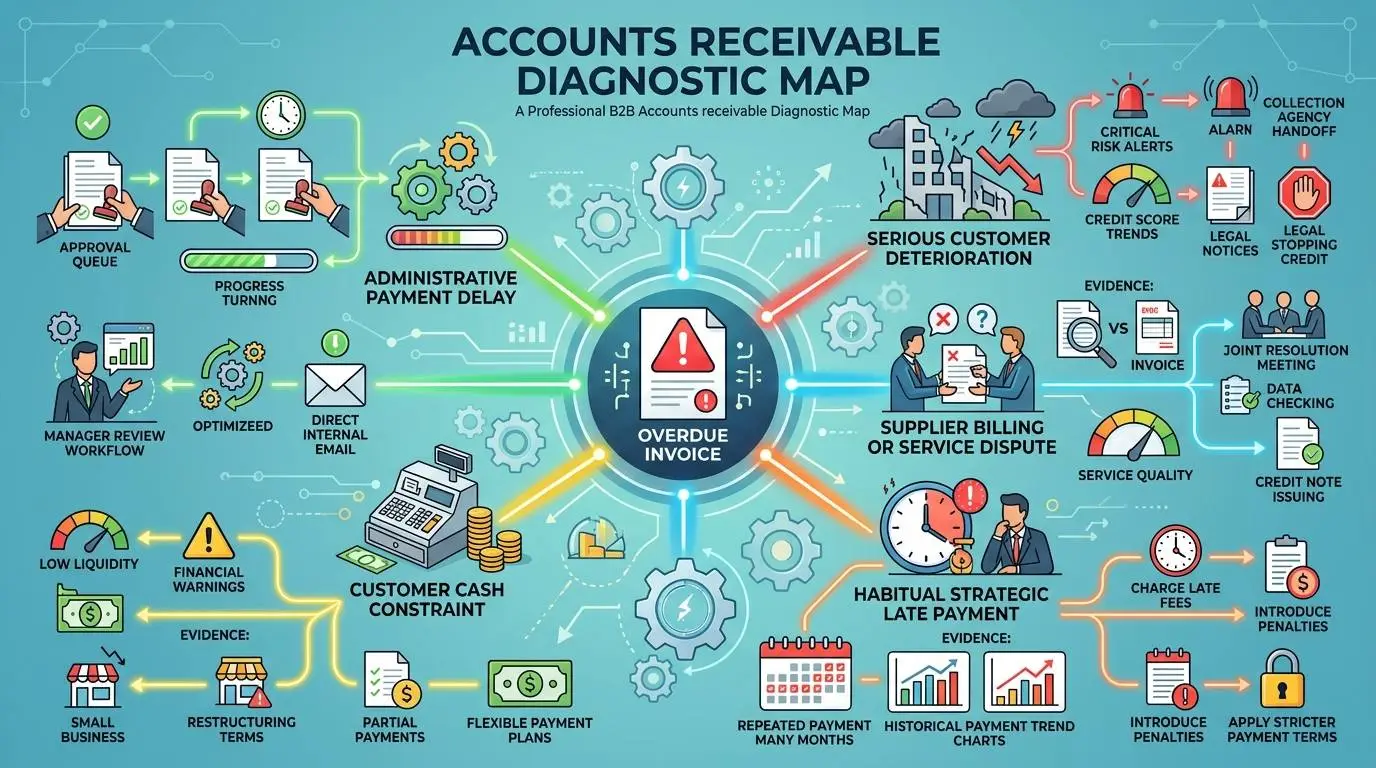
An overdue invoice generally falls into one of five operational states.
| Account state | What is actually happening | Evidence management should seek | Appropriate response |
|---|---|---|---|
| Administrative delay | The customer intends to pay but the invoice is stuck in its process | Confirmation of receipt, approval status, scheduled payment date, missing PO or vendor record | Remove the administrative obstacle and secure a dated commitment |
| Supplier-caused dispute | The customer believes the invoice, service, scope, or documentation is wrong | Contract, approval, work records, invoice detail, correspondence, disputed amount | Pause routine reminders on the disputed amount and assign resolution ownership |
| Customer cash constraint | The customer accepts the obligation but cannot pay according to terms | Direct acknowledgment, proposed payment plan, wider slowdown, broken promises | Make a credit decision rather than continuing ordinary reminders |
| Habitual strategic delay | The customer has cash but routinely pays only after pressure | Payment history, repeated lateness, response pattern, purchasing leverage | Tighten follow-up, revise terms, reduce exposure, or price the behavior into the relationship |
| Avoidance or serious deterioration | The customer will not engage, repeatedly breaks commitments, or shows distress signals | Unanswered contacts, returned communications, litigation or lien indicators, supplier complaints, leadership changes | Escalate internally, stop increasing exposure, and evaluate external recovery options |
The customer may move from one state to another.
An invoice can begin as an administrative delay, become a dispute after someone reviews it, and later become a cash-risk problem when the customer asks for extended terms.
That is why “days overdue” is not enough to determine the next action.
A 20-day-old invoice with a confirmed payment date may be less risky than a five-day-old invoice that the customer denies receiving or refuses to discuss.
Why Business Owners Avoid Following Up
Avoidance is often interpreted as weak financial discipline. That explanation is incomplete.
These incentives become harder to manage when a manual accounts receivable workflow distributes status across finance, sales, operations, and account management without one shared next action.
There are usually deeper organizational incentives behind it.
The person protecting the relationship does not bear the financing cost
The account manager sees the client’s satisfaction, renewal probability, and future pipeline.
Finance sees unpaid receivables, payroll timing, contractor obligations, borrowing, and concentration risk.
Both views are legitimate, but they are not economically symmetrical.
When an account manager asks finance to “give the customer more time,” the company is making a credit decision. It is agreeing to finance the customer for longer than the contract originally required.
The decision may be justified. But it should be visible.
It should answer:
- How much additional exposure is being approved?
- Until what date?
- In exchange for what commitment?
- Who has authority to approve it?
- What happens if the commitment is missed?
Without those answers, relationship management becomes informal lending.
The supplier suspects it contributed to the delay
Owners also avoid follow-up when they are not confident the invoice can withstand scrutiny.
Perhaps the scope changed verbally. Perhaps the final deliverable was late. Perhaps the invoice description is vague. Perhaps the customer asked a question that nobody resolved.
In that case, the discomfort is useful information.
The company should not compensate for weak documentation by staying silent. It should establish the facts quickly, acknowledge any valid error, correct the invoice if necessary, and separate the undisputed amount from the issue under review.
Delay does not strengthen a weak claim. It merely makes the evidence harder to reconstruct.
Revenue is treated as more important than collectability
A client can look valuable in the sales report while consuming working capital and management attention.
Suppose a client generates $300,000 in annual revenue but:
- Pays 30–45 days beyond agreed terms
- Requires repeated executive intervention
- Disputes invoices after work is completed
- Receives exceptions unavailable to other customers
- Causes the supplier to borrow against delayed cash
- Continues receiving new services while old balances remain open
The relationship may still be profitable.
But revenue alone cannot prove it.
The business must examine contribution margin, collection cost, financing cost, dispute frequency, write-offs, and the amount of new exposure created before payment.
A large late-paying customer is not automatically a strategic asset. It may be a strategic risk with attractive revenue.
No one has authority to change the commercial posture
Finance may be allowed to send reminders but not allowed to:
- Negotiate a payment plan
- Stop new work
- Place the account on credit hold
- Involve the owner
- Change future payment terms
- Transfer the matter to counsel or an agency
The collection team is then responsible for an outcome without controlling the available decisions.
This produces repetitive emails because email is the only approved action.
More reminders cannot substitute for escalation authority.
Polite Reminder and Collection Escalation Are Different Jobs
A polite reminder answers:
“Was this invoice received, and is anything preventing scheduled payment?”
A collection escalation answers:
“The agreed payment has not occurred, prior commitments have not resolved the matter, and the supplier is changing its commercial response.”
The difference is not simply tone.
It is the amount of evidence collected, the clarity of the request, the seniority of the sender, and the consequences attached to continued nonpayment.
Stage 1: Establish operational truth
The first contact should verify:
- The invoice was received
- The correct entity was billed
- Required documentation is present
- No dispute is open
- The payment date is understood
- The correct payment contact is involved
A useful message is specific:
“Our records show invoice 1048 for $24,600 was due on August 1. Could you confirm that it has entered your payment process and let us know the scheduled payment date? If any approval or documentation is missing, please identify it so we can resolve that promptly.”
The purpose is not pressure. It is classification.
A vague “just checking in” email may preserve a friendly tone, but it often fails to produce decision-useful information.
Stage 2: Obtain a credible commitment
“Payment is being processed” is not a payment commitment.
A credible commitment contains:
- An amount
- A date
- A method or payment run
- A person responsible
- Any condition that must first be satisfied
The collector should convert ambiguity into an observable next event.
For example:
“Thank you for confirming approval. Please confirm whether the full $24,600 will be included in Friday’s payment run and when remittance details will be available.”
This is still professional. It is also harder to evade.
Stage 3: Test whether the commitment can be trusted
A promise-to-pay date is evidence, but it is not cash.
If the date is missed, the account has changed state.
The issue is no longer merely that the original invoice was late. The customer has also failed to perform against a later commitment.
That should trigger a different response:
- More senior contact
- Clear acknowledgment of the missed commitment
- A revised deadline
- Review of ongoing service or credit exposure
- Possible payment-plan discussion
- Internal escalation
Continuing to send the same reminder after a broken promise teaches the customer that the dates have no commercial significance.
Stage 4: Change the commercial posture
Escalation should become firmer when one or more of the following occurs:
- The customer stops responding
- A promised date is missed
- New work is increasing the balance
- The customer disputes only after repeated follow-up
- The explanation changes
- The requested documents have already been supplied
- The customer is paying other obligations selectively
- The balance exceeds approved exposure
- The customer asks for additional work without addressing the debt
At this point, the message should state the operational consequence under consideration rather than merely sounding more frustrated.
For example:
“The balance remains unpaid after the agreed payment date of August 16. Before we continue work scheduled for next week, we need confirmation of payment or an approved written arrangement by August 20. We would prefer to resolve this directly and avoid disruption.”
A consequence should never be mentioned casually.
If management is not prepared to pause work, revise terms, require a deposit, or escalate the account, the message should not imply otherwise.
Empty threats weaken future collection efforts.
A Dispute Is Not an Overdue-Payment Problem
An invoice can be overdue in the accounting system while being uncollectable in its current form.
That distinction is critical.
A customer may dispute:
- The amount
- The rate
- The quantity
- The tax treatment
- The completion status
- The quality of the work
- The scope
- A missing credit
- A duplicate invoice
- An unapproved expense
- The legal entity billed
Sending more reminders does not resolve any of these questions.
The business needs a separate dispute workflow with:
- A reason code
- The amount disputed
- The amount not disputed
- Supporting documents
- A decision owner
- A response deadline
- Credit-approval authority
- A record of the root cause
NACM guidance notes that disputes frequently require collaboration outside collections, especially with sales and customer service, and that exception handling becomes inconsistent when routing and authority are undefined. It also recommends tracking dispute causes so recurring pricing, service, billing, or documentation failures can be corrected earlier in the process.
Do not allow a partial dispute to hide the entire balance
Assume a $40,000 invoice includes a disputed $5,000 change-order charge.
The company should not automatically treat the entire $40,000 as either fully collectible or fully disputed.
Management should determine:
- Is the $35,000 base amount accepted?
- Can it be paid while the $5,000 is reviewed?
- Does the contract permit separation?
- Is the customer using the smaller dispute to delay the whole invoice?
- Has the supplier clearly documented the undisputed amount?
The commercial goal is to isolate the genuine decision rather than allow the whole account to become ambiguous.
Dispute age should be measured separately
An aging report may show that an invoice is 45 days overdue.
That does not show that the internal operations team has allowed a pricing dispute to sit untouched for 28 days.
For advisory purposes, management should measure at least two clocks:
- Payment delinquency: How far beyond the agreed due date is the invoice?
- Decision latency: How long has the disputed issue waited for an internal decision?
A company can appear to have a customer-payment problem when the real delay is its own inability to approve a credit or defend the charge.
Strategic Clients Need Governance, Not Immunity
A strategic client may deserve a different communication path.
It should not receive an undefined exemption from payment discipline.
A controlled exception should specify:
- The executive owner
- The reason for the exception
- The maximum balance allowed
- The expiration date
- The customer commitment obtained
- Whether new work may continue
- What event ends the exception
Without these elements, “strategic client” becomes a label used to postpone decisions.
Measure the exposure created by continuing service
Consider an illustrative agency account:
- Existing overdue balance: $64,000
- Direct monthly payroll and contractor cost supporting the client: $18,000
- Additional third-party media or production exposure: $12,000
- Expected payment date: unknown
- New project likely to begin within two weeks
If work continues for another month without payment, the company may increase exposure from $64,000 to approximately $94,000 before considering overhead.
That is not merely relationship preservation.
It is a decision to invest another $30,000 in the customer.
Management should compare that investment with:
- The likelihood and timing of collection
- Gross margin on future work
- Replacement cost of the client
- Customer concentration
- Contractual rights
- The risk that stopping work damages recovery
- The risk that continuing work makes the eventual loss larger
The correct decision may still be to continue.
But it should be approved as a commercial-risk decision, not allowed to happen because nobody wants to make a phone call.
When Automation Helps
As the accounts receivable automation guide explains, automation is valuable when the account state is known and the next action follows a stable rule.
It can reliably:
- Send a receipt-confirmation message
- Trigger a pre-due check for high-value invoices
- Assign follow-up tasks
- Record delivery failure
- Escalate an unanswered account
- Track a promised payment date
- Pause reminders after payment
- Route disputes
- Alert management when exposure exceeds a limit
- Preserve a consistent communication history
AFP identifies automatic follow-up, digital billing, customer portals, workflow visibility, dispute metrics, and other AR controls as ways to improve efficiency and predictability. It also emphasizes that automation should free staff for customer relationships, analysis, and working-capital decisions rather than remove judgment from the process.
When Automation Makes Communication Worse
Automation becomes dangerous when the system knows the invoice age but not the commercial context.
It can damage the relationship when:
- A payment has arrived but remains unapplied
- A dispute exists outside the accounting system
- A salesperson privately promised an extension
- The invoice was issued incorrectly
- The customer has entered an approved payment plan
- A senior executive is already negotiating resolution
- Service has been paused
- Counsel has advised that communications be controlled
- A strategic account requires coordinated contact
- The customer’s contact has changed
The operational requirement is not merely an automated sequence.
It is a sequence with stop conditions, exception states, ownership, and auditable overrides.
Every override should also expire.
Otherwise an account manager can suppress reminders indefinitely and convert a temporary exception into permanent uncontrolled credit.
When Should Service Be Paused?
Service suspension should not be used as emotional punishment.
It is a risk-control decision intended to prevent the business from increasing exposure when the customer has not met its obligations.
Before pausing service, management should examine five questions.

1. Is the debt genuinely due?
Confirm that:
- The invoice is accurate
- The work was delivered
- Required approvals exist
- The customer received the invoice
- Any dispute has been evaluated
- Payment terms are clear
Pausing service over a supplier-caused billing mistake can create unnecessary legal and relationship risk.
2. How much new exposure is being created?
A low-cost recurring service may justify short-term continuation.
A project requiring large payroll, materials, media spend, hardware, travel, or subcontractor commitments may not.
The decision should consider the marginal cash at risk, not only the existing receivable.
3. Is the client communicating credibly?
A customer that shares facts, provides a date, makes partial payments, and meets revised commitments presents a different risk from one that avoids contact or repeatedly breaks promises.
Communication alone is not enough, but reliable behavior is meaningful evidence.
4. What does the contract permit?
The company should review payment terms, notice requirements, cure periods, suspension rights, termination provisions, and obligations relating to work in progress.
This is a contractual and potentially legal question. Generic business advice cannot determine the company’s rights in a specific situation.
5. Will suspension improve or reduce collectability?
Stopping work can create leverage.
It can also:
- Prevent the customer from generating the revenue needed to pay
- Damage a valuable long-term relationship
- Trigger a counterclaim
- Leave work incomplete
- Reduce the practical value of delivered services
- Cause the customer to replace the supplier
The correct objective is not maximum pressure.
It is the best risk-adjusted recovery outcome.
When Finance, Leadership, or Legal Review Should Enter
Finance should lead when the problem is measurable and procedural
Finance should usually own:
- Balance confirmation
- Payment history
- Aging
- Promise-to-pay tracking
- Credit exposure
- Payment-plan monitoring
- Cash forecasting
- Documentation of collection activity
Finance should not be expected to decide whether disputed work met the contract.
Account management or operations should lead when performance is disputed
The person closest to the work should establish:
- What was promised
- What was delivered
- What changed
- What the customer approved
- Whether the complaint has merit
- What correction is commercially appropriate
Finance can coordinate the workflow, but it cannot resolve facts it does not own.
Senior leadership should enter when the company’s commercial posture must change
Leadership involvement is appropriate when:
- The customer is strategically important
- Exposure exceeds an internal limit
- A payment commitment has been broken
- Work suspension is being considered
- Future terms must change
- The account creates customer-concentration risk
- Sales and finance cannot agree
- An exception requires executive approval
The purpose of executive escalation is not to send a more intimidating email.
It is to make a decision that lower-level staff lack authority to make.
Legal or external collection review should be economic, not emotional
Legal escalation may become appropriate when:
- The amount is material
- The documentation is strong
- The customer refuses meaningful engagement
- Internal collection efforts have reached their limit
- Contractual deadlines or security rights require attention
- The customer appears to be deteriorating financially
- The expected recovery justifies the cost
- Management needs advice before suspending or terminating service
NACM notes that litigation costs and filing expenses may make negotiated payment arrangements more economical in some cases. That does not mean payment plans are always preferable; it means recovery options should be compared on expected cost, time, collectability, and business impact.
The federal Fair Debt Collection Practices Act generally covers consumer debts rather than business debts. However, that does not make commercial collections legally unrestricted. Contracts, state laws, industry rules, licensing requirements, fraud concerns, bankruptcy rules, and other obligations may still matter. Businesses should obtain qualified advice for their circumstances.
A Relationship-Safe Escalation System
A sound collection process becomes more direct as evidence of risk increases.
It does not simply become angrier.
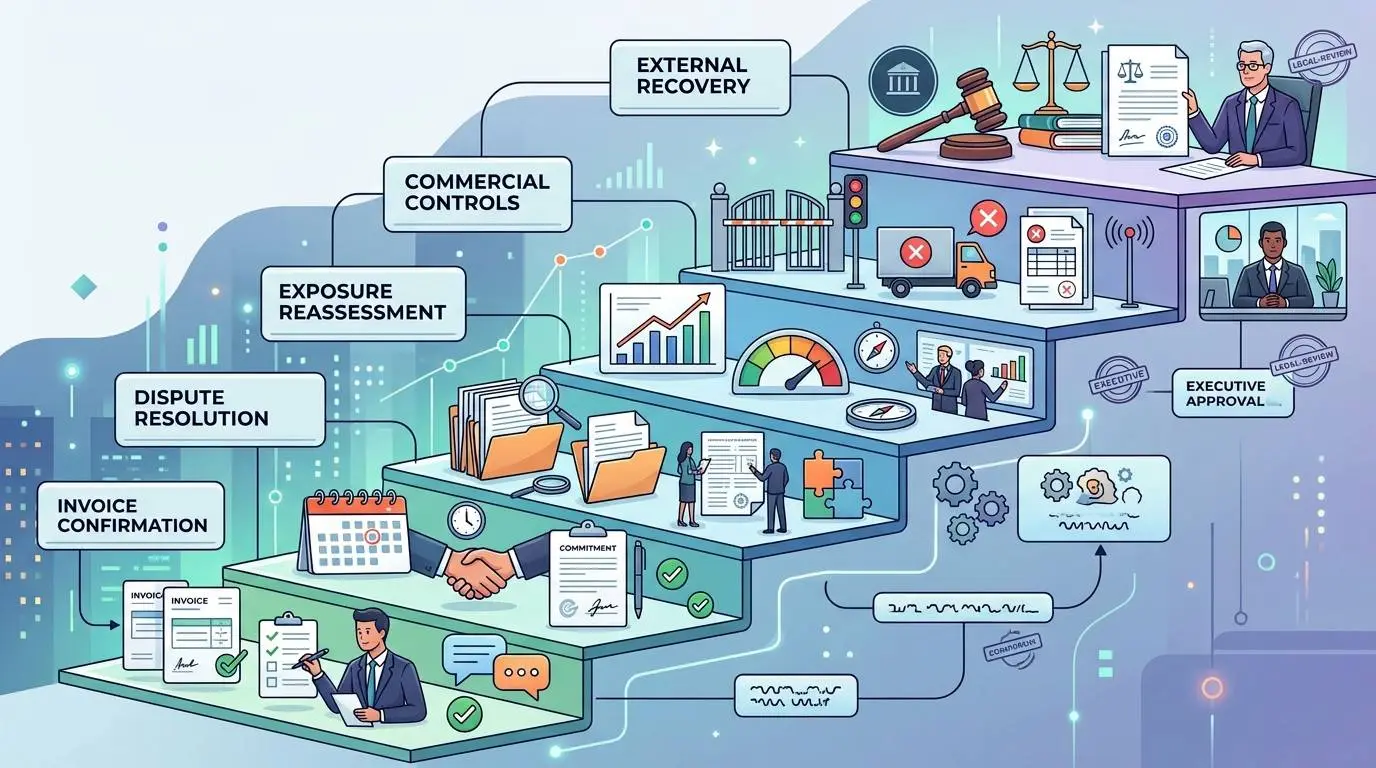
| Escalation level | Management objective | Required evidence | Appropriate owner |
|---|---|---|---|
| Clarify | Confirm receipt, approval, and payment process | Invoice, delivery evidence, contact details | AR or bookkeeper |
| Commit | Obtain amount and payment date | Customer acknowledgment, scheduled run | AR or finance |
| Resolve | Remove a dispute or administrative blocker | Contract, approval, disputed amount, documents | Operations plus finance |
| Reassess | Decide whether continued exposure is justified | Payment history, broken promises, account profitability, new work | Finance and account leadership |
| Control | Change terms, pause service, require payment plan, or escalate recovery | Complete account file and management approval | Senior leadership |
| Recover | Pursue external collection or legal options | Contract, invoices, delivery evidence, communications, collectability assessment | Leadership and qualified advisers |
This system protects the relationship because the customer receives a coherent response.
It also protects the supplier because friendliness is not allowed to replace accountability.
What Management Should Review After Every Serious Overdue Case
The business should not close the file merely because payment finally arrived.
A late payment is operational evidence.
Management should ask:
- Did the delay begin before the invoice was issued?
- Was the invoice accurate?
- Did the correct customer contact receive it?
- How long did the customer take to identify the problem?
- How long did the supplier take to respond?
- Was the undisputed amount collected?
- Was a payment promise recorded?
- Did the customer meet that promise?
- Did the company continue increasing exposure?
- Did sales, operations, and finance send a consistent message?
- Should future terms, deposits, credit limits, or approval rules change?
Repeated disputes should become process-improvement data.
Repeated broken promises should become credit-risk data.
Repeated strategic exceptions should become customer-profitability data.
Without that feedback loop, the company may collect the invoice while preserving the cause of the next delay.
For each one, identify the payment obstacle, the undisputed amount, the next customer commitment, the internal decision owner, and the additional exposure being created while service continues.
The Practical Conclusion
Following up on overdue invoices without damaging client relationships is not mainly a writing exercise.
The business does not need endlessly softer email templates.
It needs to know:
- Why the invoice is unpaid
- Whether the customer accepts the obligation
- What evidence supports the company’s position
- Who owns the next decision
- What commitment has been secured
- How much additional exposure is being created
- What consequence management is prepared to enforce
A relationship is not protected by avoiding financial reality.
A strong relationship can withstand a clear conversation about an agreed obligation. A weak process cannot withstand months of ambiguity, internal disagreement, and growing exposure.
The best overdue follow-up is therefore neither aggressive nor passive.
It is diagnostic first, specific second, and progressively consequential when the evidence requires it.
The question is not:
“How many reminders should we send?”
The better question is:
“What is preventing payment, who can remove that obstacle, and how much more risk are we willing to accept while we wait?”
This guide provides general business information, not accounting, financial, credit, collection, contractual, or legal advice. Commercial collection rights, service-suspension rules, notice requirements, and recovery options depend on the agreement, industry, jurisdiction, and facts. Verify current requirements and obtain qualified advice before changing service, credit, or legal posture.