
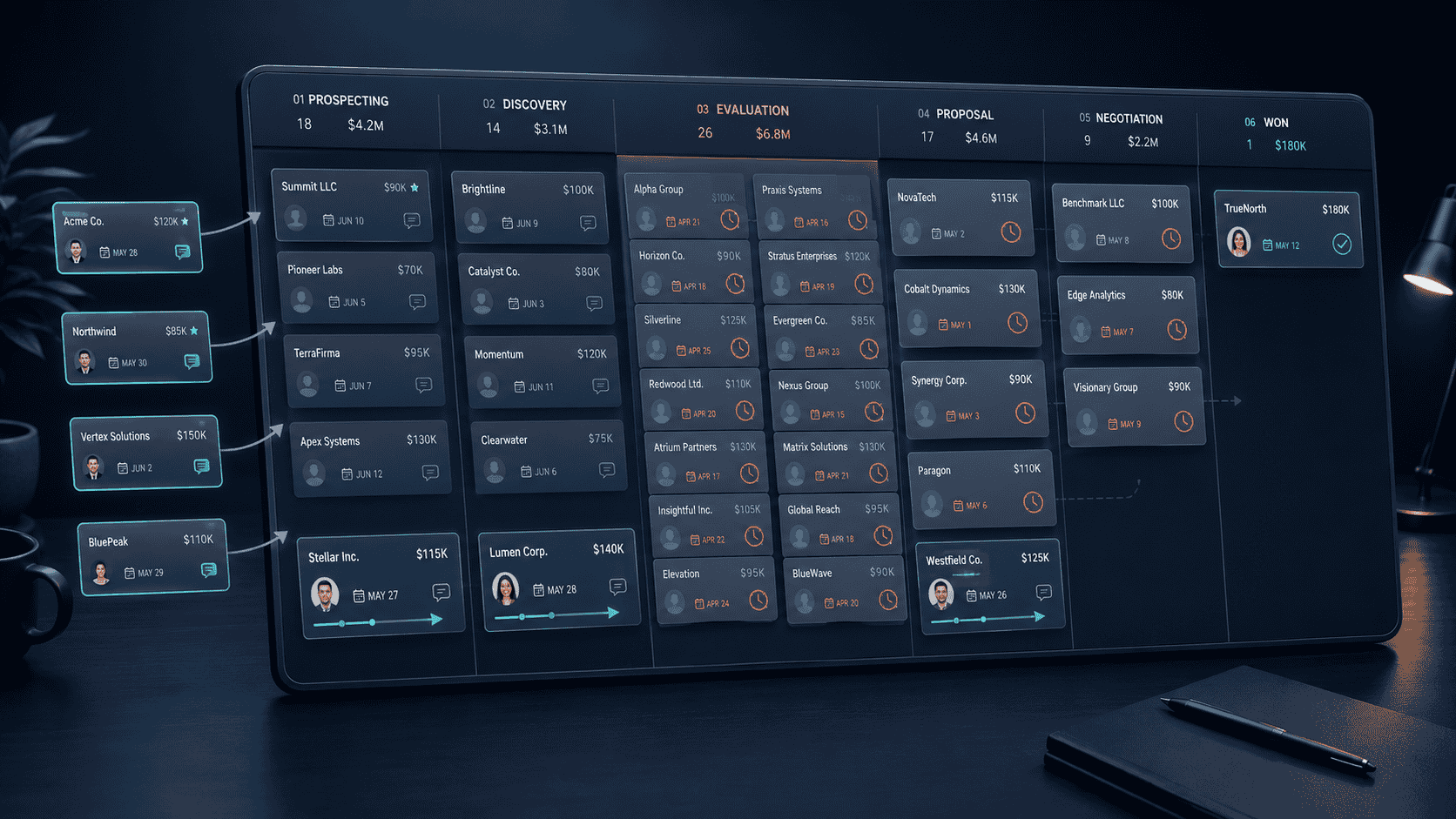
- Pipeline age alone is not the problem; the real issue is an open opportunity without recent buyer progress, a credible next action, or a justified delay.
- Stages should represent buyer milestones rather than seller activity such as “contacted” or “proposal sent.”
- Every active opportunity should have one accountable owner, one dated next action, and evidence supporting its current stage.
- Weak opportunities should be recycled or closed instead of remaining active merely to protect pipeline coverage.
- Technology can enforce alerts and tasks, but management must define qualification, stage evidence, aging thresholds, and forecasting discipline.
Affiliate disclosure: Pulse & Prime is an independent HighLevel affiliate, not an employee or representative of HighLevel. We may earn a commission if you subscribe through links on this page, at no additional cost to you. Our analysis and opinions are our own.
The owner of a 22-person consulting firm opens the CRM before Monday’s sales meeting.
The dashboard shows $1.4 million in pipeline value.
Four opportunities are marked “Proposal Sent.” Three are in “Negotiation.” Another six are classified as “Follow-Up” or “Decision Pending.”
On paper, the next quarter looks promising.
During the meeting, however, the updates sound almost identical to the previous week:
“I’m waiting to hear back.”
“They seemed interested.”
“Their team is reviewing the proposal.”
“I’ll follow up again.”
“They may decide next month.”
Several expected close dates are moved forward by another 30 days. No one can immediately identify the last meaningful conversation with two of the largest prospects. One proposal was sent seven weeks ago without a scheduled review meeting. Another opportunity belongs to a salesperson who left the company last month.
The pipeline value remains high.
Revenue does not move.
The company does not actually have $1.4 million in active buying decisions. It has $1.4 million in unresolved sales history.
That distinction explains why stale pipelines are rarely fixed by telling salespeople to follow up more often.
A stale pipeline is usually the visible result of a deeper operating failure. Opportunities enter without sufficient qualification. Stages describe seller activity rather than buyer progress. Next actions are optional. Customer delays are recorded but not managed. Weak opportunities remain open because closing them would expose how little credible pipeline exists.
The CRM does not create the problem.
It makes the problem look organized.
What a Stale Sales Pipeline Actually Means
Opportunity age alone is a poor definition of pipeline health.
A six-month consulting opportunity may be healthy if the buyer has completed discovery, involved the decision-maker, approved the business case, and scheduled a budget decision for October.
A ten-day inbound opportunity may already be stale if nobody owns it and no contact attempt is scheduled.
An operational definition is more useful:
An opportunity becomes stale when it remains open without recent evidence of buyer progress, a credible next action, a responsible owner, or a justified reason for delay beyond the normal threshold for that stage and type of sale.
Management should distinguish five different clocks:
- Time since the opportunity entered its current stage
- Time since the salesperson completed an activity
- Time since the customer meaningfully engaged
- Time until the next scheduled action
- Expected duration of that specific buying process
These clocks do not measure the same thing.
A salesperson can send five emails without producing any buyer progress. The CRM may show recent activity, but the opportunity remains commercially unchanged.
This is the difference between:
Seller activity: An email was sent, a voicemail was left, or a task was completed.
Customer engagement: The buyer replied, attended a meeting, reviewed material, or supplied information.
Buyer commitment: The buyer agreed to involve another stakeholder, provide data, review a proposal, secure approval, or decide by a specific date.
Commercial progress: The opportunity moved closer to a purchase because a meaningful uncertainty was removed.
A healthy pipeline measures the last two, not merely the first.
Why Pipeline Size Creates False Confidence
Total pipeline value gives management a simple number to discuss.
That simplicity makes it attractive—and dangerous.
Suppose a company has 40 open opportunities valued at $25,000 each. The CRM shows a $1 million pipeline.
That number says nothing about whether:
- The contacts fit the company’s target market
- The buyer has confirmed a need
- A decision-maker is involved
- The estimated values are credible
- The expected close dates reflect buyer evidence
- The opportunities are duplicates
- The customer has agreed to a next step
- The salesperson is still actively pursuing them
Pipeline value is especially vulnerable to inflation when opportunities are created automatically from every inquiry, webinar registration, form submission, or introductory conversation.
The apparent strength of the pipeline then comes from the company’s willingness to classify interest as potential revenue.
A large opportunity portfolio can also dilute sales attention. Empirical research on sales opportunity coverage found that pursuing too many opportunities can overload representatives, reduce goal commitment, and weaken sales performance. The implication is not that a small pipeline is always better. It is that opportunity volume must be matched to realistic sales capacity and prioritization. Pipeline value remains useful when it is accompanied by evidence such as:
- Qualification status
- Buyer milestones completed
- Last meaningful engagement
- Next action and due date
- Stage-specific conversion history
- Repeated close-date changes
- Documented delay reason
- Opportunity concentration
- Representative capacity
Without this evidence, the total is not a forecast.
It is an inventory count.
Opportunities Enter Before They Are Qualified
Many stale pipelines are created at the entrance.
The business treats every person who expresses interest as an active sales opportunity.
But interest can mean many things:
- The person downloaded information
- The company is researching a future project
- An employee is collecting prices
- The buyer has a problem but no budget
- The contact likes the offer but lacks authority
- The customer fits the market but is committed to another provider
- The inquiry is genuine and commercially urgent
These contacts should not receive identical pipeline treatment.
Before a record becomes an active opportunity, management should seek evidence across several dimensions:
Problem: Is there a real customer need that the offer can solve?
Fit: Can the company serve the customer operationally and profitably?
Authority: Is the contact a decision-maker or connected to the buying group?
Ability: Is there a plausible route to funding or purchasing?
Timing: Is there an actual buying period or triggering event?
Commitment: Is the customer willing to complete a meaningful next step?
Recent B2B opportunity-management research emphasizes the need to prioritize opportunities because firms have limited resources and often rely on intuition or ad hoc pursuit rules. The research separates initial qualification and opportunity selection from later win decisions—an important distinction for companies that currently allow every lead into the active pipeline. Premature opportunity creation produces three downstream effects.
First, the pipeline looks stronger than it is.
Second, representatives must divide their attention across contacts that have not earned active sales resources.
Third, legitimate opportunities receive less focused follow-up because they are mixed with low-intent records.
Management may respond to low conversion by demanding more leads. Marketing then feeds more records into the same overloaded process.
The visible problem is stalled deals.
The originating problem is an undisciplined entry definition.
Pipeline Stages Describe Seller Activity Instead of Buyer Progress
Stage names such as these are common:
- Contacted
- Follow-Up
- Interested
- Proposal Sent
- Negotiation
- Waiting
- Decision Pending
They sound reasonable but are operationally weak.
“Contacted” may mean the salesperson sent an unanswered email.
“Interested” may mean the prospect was polite during a call.
“Proposal Sent” confirms that the seller delivered a document. It does not show that the buyer reviewed it, accepted its assumptions, involved the correct stakeholders, or agreed to a decision process.
“Negotiation” may describe a real commercial discussion—or merely the salesperson’s hope that one will begin.
A strong stage represents a verifiable change in the buyer’s process.
Instead of asking, “What did the salesperson do?” management should ask:
- What has the buyer completed?
- What evidence confirms it?
- What uncertainty was removed?
- What must happen before the opportunity advances?
For example:
| Weak stage | Stronger buyer milestone |
|---|---|
| Contacted | Discovery conversation completed and need confirmed |
| Interested | Buyer agreed to evaluate a defined solution |
| Proposal sent | Proposal review scheduled with relevant stakeholders |
| Negotiation | Commercial terms actively under review by an authorized buyer |
| Decision pending | Decision process, participants, and date confirmed |
Stage-entry and exit criteria reduce storytelling.
They do not eliminate judgment. Complex B2B buying processes cannot always be represented perfectly by a few columns.
The goal is not perfect classification.
The goal is ensuring that two representatives use the same stage for approximately the same commercial condition.
Active Opportunities Have No Required Next Action
An opportunity without a next action is not being actively managed.
“Follow up later” is not a next action.
Neither is:
- Check in
- Wait for response
- Touch base next month
- Keep warm
- See what happens
A meaningful next action contains:
- A specific action
- A responsible person
- A due date
- An expected customer outcome
- A response if the action fails
For example:
Account executive will call the operations director on August 6 to confirm whether finance approved the implementation budget. If there is no response by August 8, the sales manager will review whether to recycle or close the opportunity.
This next action exposes the real dependency.
The deal is not vaguely “waiting.” It is waiting for a budget decision from a known party by a known date.
Without this structure, opportunities disappear into personal calendars, inboxes, notebooks, and memory. The CRM preserves the opportunity value while losing the operating commitment needed to advance it.
Follow-Up Depends on Individual Memory
Small sales teams often resist structured follow-up because representatives want flexibility.
Some flexibility is necessary. A strategic consulting sale should not be handled like a missed-call inquiry.
The problem appears when flexibility means every representative invents a private process.
One salesperson follows up twice.
Another follows up seven times.
A third remembers high-value opportunities but forgets smaller ones.
A fourth manages everything through a personal inbox that nobody else can inspect.
This makes performance dependent on the memory, habits, workload, and continued employment of individual people.
It also makes coaching difficult. Management cannot determine whether an opportunity failed because the buyer disengaged, the message was weak, the cadence was inappropriate, or follow-up never occurred.
The solution is not to automate every customer contact.
Routine control can be automated:
- Task creation
- Due-date reminders
- Inactivity alerts
- Assignment notifications
- Appointment confirmations
- Internal escalation
- Recycling dates
Human judgment should remain responsible for:
- Interpreting buyer hesitation
- Adjusting the value proposition
- Navigating multiple stakeholders
- Negotiating terms
- Determining whether continued pursuit is economical
- Deciding when to close or recycle the deal
Automation should protect the process from omission.
It should not replace commercial judgment.
Ownership Is Assigned but Not Accepted
A name in the owner field creates apparent accountability.
It does not prove that responsibility was accepted.
Opportunities stall when:
- A shared inbox receives the original inquiry
- Territories overlap
- Appointment setters and closers have unclear boundaries
- A representative changes roles
- A deal is reassigned without conversation history
- An employee leaves
- The CRM owner differs from the person actually communicating with the customer
A functional handoff requires more than changing a dropdown field.
The receiving owner needs:
- Customer and company context
- Original source and offer
- Qualification evidence
- Conversation history
- Current stage and supporting evidence
- Existing commitments
- Required next action
- Due date
The new owner should also know that the transfer occurred.
Customer data quality research shows that CRM accuracy is not merely a technical issue. Organizational culture, data sharing, cross-functional cooperation, and executive leadership materially influence the quality of customer information and its performance value. Managers cannot solve ownership problems by adding mandatory fields alone.
They must establish who maintains the information, who verifies it, and what happens when the record is incomplete.
Customer Delay Is Recorded but Not Managed
Customers delay decisions for legitimate reasons.
They may be waiting for:
- A new fiscal year
- Budget approval
- Legal review
- Procurement
- A contract expiration
- Another executive
- Internal capacity
- Reduced implementation risk
- A triggering event
A long decision cycle is not automatically a stale opportunity.
The difference is evidence.
A healthy delayed opportunity might include:
Customer’s current contract ends November 30. Procurement review begins October 15. Account executive will reconnect September 20 with updated implementation options.
A weak delayed opportunity might include:
They are not ready. Follow up in a few months.
The first record includes a reason, trigger, date, and action.
The second stores optimism.
Management should classify delayed prospects into three groups:
Active delay: The buyer has a defined process and scheduled next event.
Recycling or nurture: The customer fits, but there is no active buying process. A future trigger or review date exists.
Effectively lost: No buyer commitment, no credible trigger, and no evidence that continued pursuit deserves active capacity.
Leaving all three in the active pipeline creates false volume and weak forecasts.
Salespeople Keep Weak Deals Open
Managers often blame representatives for refusing to close dead opportunities.
But the behavior may be rational inside the company’s incentive system.
A representative may keep weak deals open because:
- Management expects a certain pipeline coverage ratio
- Closing opportunities makes the forecast look worse
- There is no recycling process
- The salesperson has invested significant time
- The buyer never said an explicit “no”
- Closed-lost criteria are unclear
- The representative fears being judged for failure
- The manager rewards pipeline creation more visibly than honest qualification
Research using CRM data has found that salespeople and sales managers can differ in their evaluation of opportunities, with optimism, confidence, and overconfidence affecting judgments. This supports the need for evidence-based reviews rather than assuming that opportunity assessments are neutral. Management should make it safe to close weak deals.
Closing an opportunity should not mean deleting the relationship permanently.
A legitimate future prospect can be recycled with:
- A reason
- A future trigger
- A review date
- Appropriate communication
- A named owner
This allows the active pipeline to shrink without destroying future demand.
A smaller pipeline with stronger evidence is more useful than a larger pipeline protected by hope.
Overdesigned Pipelines Create Bad Data
Some managers respond to poor visibility by adding more stages, fields, approvals, and reporting requirements.
This can produce the opposite result.
When representatives must choose among 18 overlapping stages, complete dozens of fields, or duplicate the same information across several systems, updates become late and inaccurate.
The tradeoff is real.
Management needs enough structure to evaluate movement.
Sales needs a process that can be maintained during real customer work.
A practical pipeline should capture only information that changes one of four decisions:
- Should the company pursue the opportunity?
- What must happen next?
- How should management allocate attention?
- Should the opportunity advance, pause, recycle, or close?
Fields that do not influence a decision should be questioned.
Disconnected Tools Separate the Pipeline From Reality
The customer conversation may exist across:
- SMS
- Phone history
- Video meetings
- Calendar tools
- Proposal software
- Forms
- Spreadsheets
- The CRM
Each system can tell a different version of the same opportunity.
The CRM says “Proposal Sent.”
The salesperson’s inbox contains a customer objection.
The calendar shows that the review meeting was canceled.
The text-message platform contains a request to reconnect next quarter.
Management sees only the CRM and assumes the deal is active.
Specialized tools are not inherently inferior. A mature organization may need separate systems for proposals, calling, customer success, analytics, and enterprise CRM.
Integration becomes an operating risk when the company cannot reliably preserve:
- Customer identity
- Conversation history
- Ownership
- Stage
- Next action
- Outcome
The relevant question is not how many tools the business uses.
It is whether management can reconstruct the opportunity without interviewing several employees.
Management Reviews Stories Instead of Exceptions
A weak pipeline meeting asks:
“What is happening with this deal?”
The representative tells a story.
A stronger review begins with exceptions:
- Opportunities without a next action
- Deals exceeding the normal stage threshold
- Repeatedly postponed close dates
- Proposals without a review meeting
- Opportunities without recent buyer engagement
- Unassigned records
- Deals owned by inactive employees
- Opportunities that should be recycled
- Differences in stage conversion by representative
- Lost reasons that are missing or overly broad
Forecast research shows that managerial accuracy depends on context, experience, confidence, and the nature of the sales cycle. Forecast judgment should therefore be treated as conditional rather than automatically reliable. The manager’s role is not to replace every judgment with a formula.
It is to test optimism against observable evidence.
The Financial Cost of a Stale Pipeline
A stale opportunity does more than delay one possible sale.
It distorts decisions across the business.
Consider an illustrative scenario.
A company reports:
- 30 active opportunities
- Average recorded value: $20,000
- Total pipeline: $600,000
An audit finds:
- 8 opportunities have no next action
- 5 have had no meaningful buyer interaction for 45 days
- 4 are unqualified inquiries
- 3 have had their expected close date moved at least three times
Assume some records overlap, leaving 15 opportunities without sufficient evidence to support active status.
Recorded value attached to questionable opportunities:
15 × $20,000 = $300,000
This does not prove that $300,000 will be lost.
It shows that half of the reported pipeline should not be used for planning without further review.
If management treats the full $600,000 as credible, it may:
- Hire too early
- Delay cost reductions
- Commit delivery capacity
- Forecast cash that will not arrive
- Underinvest in prospecting
- Continue weak advertising
- Ignore sales coaching needs
- Divide representatives across too many unlikely deals
The greatest cost is false confidence.
A weak pipeline prevents management from recognizing that the company has fewer real opportunities than it believed.
How an Owner Can Find the Real Stagnation Point
Select 25–40 recent open opportunities across different stages, sources, representatives, and values.
Do not begin by trusting the CRM label.
Reconstruct what actually happened.
For each opportunity, identify:
- Why it entered the pipeline
- Whether it met the qualification standard
- Buyer problem and commercial fit
- Current owner
- Evidence supporting the current stage
- Last seller activity
- Last meaningful buyer interaction
- Next action and due date
- Decision-maker involvement
- Proposal review or decision date
- Number of close-date changes
- Documented delay reason
- Complete conversation history
- Original marketing source and offer
- Appropriate final classification
The patterns reveal different management problems.
Many opportunities were never qualified
The pipeline-entry rule is too broad.
Management should separate raw leads and early qualification from active opportunities.
Qualified opportunities lack next actions
The problem is execution or accountability.
Management should require an owner, dated action, and exception alert.
Deals remain in stages for a long time but have documented buyer commitments
The sales cycle may be healthy but longer than management assumed.
Stage thresholds and forecasts should be adjusted using real historical behavior.
Close dates change repeatedly without new buyer evidence
The forecast is being maintained through optimism rather than progress.
Managers should require a buyer event before accepting another date change.
One representative has materially more stale opportunities
Possible causes include workload, coaching needs, process resistance, poor qualification, or weak data discipline.
The answer should come from reviewing actual records and conversations—not assuming the representative lacks motivation.
Proposals remain open without scheduled reviews
The company may be sending proposals before establishing the buyer’s decision process.
Management should require a proposal-review meeting or explicit decision step before moving the deal into a later stage.
Many prospects are “not ready” without future review dates
The company lacks a recycling process.
Those prospects should leave the active pipeline and enter a controlled future-contact workflow.
How to Repair a Stale Sales Pipeline
The repair should begin by making the active pipeline smaller and more credible.
Separate leads from opportunities
Use distinct operating states:
- Raw lead
- Being qualified
- Active opportunity
- Paused or nurture
- Closed lost
- Closed won
An active opportunity should require evidence of fit, a customer problem, and willingness to complete a next step.
Design stages around buyer milestones
Use a limited number of stages that reflect the actual buying process.
Each stage should define:
- Buyer action required for entry
- Evidence confirming entry
- Seller action required next
- Buyer event required for exit
- Normal time range
- Owner
Different services may need different pipelines. A local appointment sale and a six-month consulting engagement should not be forced into identical stages.
Require one owner and one next action
Every active opportunity should have:
- One accountable owner
- One dated next action
- An expected buyer outcome
- A response if the action is missed
Managers should review exceptions rather than approve every routine action.
Establish stage-specific aging thresholds
A new inbound request may become stale within hours.
Contract review may legitimately take several weeks.
Thresholds should reflect:
- Historical stage duration
- Customer segment
- Deal complexity
- Buying process
- Documented commitment
An aging alert should trigger review.
It should not automatically declare the deal lost.
Create a recycling process
A good-fit customer with no active timing should leave the active pipeline.
The recycled record needs:
- Reason
- Future trigger
- Review date
- Communication plan
- Owner
This preserves the relationship without inflating active pipeline value.
Standardize lost reasons
Use a manageable set of reasons such as:
- No commercial fit
- Could not establish contact
- No priority or decision
- Budget unavailable
- Timing delayed
- Competitor selected
- Pricing or offer mismatch
- Sales execution failure
- Duplicate or invalid inquiry
Avoid “not interested” when a more specific explanation is available.
Review movement and exceptions
Representatives should manage daily actions.
Managers should review:
- Overdue next actions
- Aging exceptions
- Unassigned opportunities
- Close-date changes
- Buyer engagement gaps
- Stage conversion
- Lost reasons
- Differences among representatives
Marketing should receive feedback on which sources create qualified opportunities and revenue.
What Technology Can and Cannot Fix
Technology can help the business:
- Capture source information
- Create opportunities consistently
- Assign owners
- Record conversations
- Create tasks and alerts
- Schedule appointments
- Track stages
- Flag inactivity
- Coordinate follow-up
- Recycle prospects
- Report conversion
It cannot determine what buyer progress means unless management defines it.
It cannot correct weak targeting, poor qualification, unclear pricing, ineffective sales conversations, conflicting incentives, or unrealistic forecasts.
It cannot create accountability where managers tolerate incomplete records.
Automating a poorly defined pipeline can produce more notifications and more seller activity without producing more buyer progress.
When a Connected Platform Such as HighLevel May Help
HighLevel is one possible implementation option for a small business currently dividing lead capture, conversations, calendars, follow-up, tasks, and pipeline records across disconnected tools.
Its official documentation confirms that HighLevel can:
- Create and manage defined pipeline stages
- Store opportunities with values, stages, statuses, sources, and assigned owners
- Assign an owner through workflows
- Trigger workflows from opportunity creation, stage changes, status changes, and stale-opportunity conditions
- Use lost reasons in workflow logic
- Create alerts, follow-up actions, and manager notifications
- Stop workflow messaging after a customer responds These capabilities may help a company test a controlled workflow:
- Capture a lead with its source context.
- Qualify it before creating an active opportunity.
- Assign one visible owner.
- Enter a buyer-based stage.
- Create the required next action.
- Coordinate follow-up.
- Flag stage-aging exceptions.
- Move the opportunity to won, lost, abandoned, or recycling based on evidence.
HighLevel may not solve the problem when:
- The existing sales stack is already mature and integrated
- The pipeline stages are undefined
- Targeting or qualification is weak
- Representatives will not maintain opportunity data
- Nobody owns implementation and training
- Migration cost exceeds the benefit
- The business requires highly specialized enterprise functionality
The product should be tested against one operating failure—not purchased because it contains a pipeline board.
Test One Real Pipeline Before Rebuilding Your Sales Stack
Use the HighLevel 30-day trial to test one real lead source and one real pipeline.
Preserve the source context, assign an owner, require a next action, coordinate follow-up, and measure whether buyer progress becomes easier to see.
A Practical 30-Day Pipeline Repair Plan
Week 1: Establish the truth
Audit 25–40 open opportunities.
Separate:
- Credible active deals
- Unqualified records
- Documented delays
- Recycling candidates
- Effectively lost opportunities
Measure the percentage with:
- Valid qualification
- Stage evidence
- Assigned owner
- Dated next action
- Recent buyer engagement
- Credible close date
Week 2: Repair the operating rules
Define:
- What qualifies as an active opportunity
- Buyer evidence for every stage
- Stage-entry and exit criteria
- Ownership rules
- Next-action requirements
- Stage-aging thresholds
- Closed-lost reasons
- Recycling rules
Remove stages and fields that do not support a real decision.
Week 3: Implement one working pipeline
Choose one lead source or sales process.
Configure:
- Source capture
- Qualification
- Opportunity creation
- Owner assignment
- Pipeline stages
- Tasks and reminders
- Aging alerts
- Recycling
- Won and lost outcomes
Train the employees on the operating rules, not only the software interface.
Week 4: Review actual movement
Inspect:
- Overdue actions
- Stage-aging exceptions
- Seller activity without buyer engagement
- Repeated close-date changes
- Inactive proposals
- Missing lost reasons
- Differences among representatives
- Opportunities that should leave the active pipeline
Compare stage movement and conversion with the baseline.
The review may show that the primary constraint is:
- Pipeline design
- Qualification
- Follow-up execution
- Sales capability
- Representative capacity
- Data quality
- Lead quality
The objective is not to prove that the new system works.
It is to identify which constraint should receive management attention next.
A Pipeline Is Only Valuable When It Shows Evidence of Progress
A business should not treat total pipeline value as expected revenue unless it can explain:
- Why each opportunity belongs in the active pipeline
- What buyer evidence supports its stage
- Who owns it
- What happens next
- When that action is due
- What will cause the deal to advance
- What will cause it to pause, recycle, or close
- Why the expected close date remains credible
Pipeline management is not primarily CRM housekeeping.
It is the operating discipline that separates real buyer progress from seller activity, optimism, and unresolved history.
A clean pipeline may look smaller.
That is not necessarily bad news.
It gives management a truthful view of the opportunities the company can actually influence—and exposes where new demand, stronger qualification, better sales execution, or different commercial decisions are required.
Test the Process, Not the Dashboard
Before buying more leads or rebuilding every sales system, test whether one controlled pipeline produces clearer ownership, stronger next actions, more reliable stage movement, and better management evidence.
This guide provides operational analysis rather than financial forecasting, legal, privacy, or communications-compliance advice. HighLevel features, trial availability, Bootcamp terms, pricing, billing, workflow capabilities, and usage charges may change. Confirm current terms on the destination page before subscribing.