
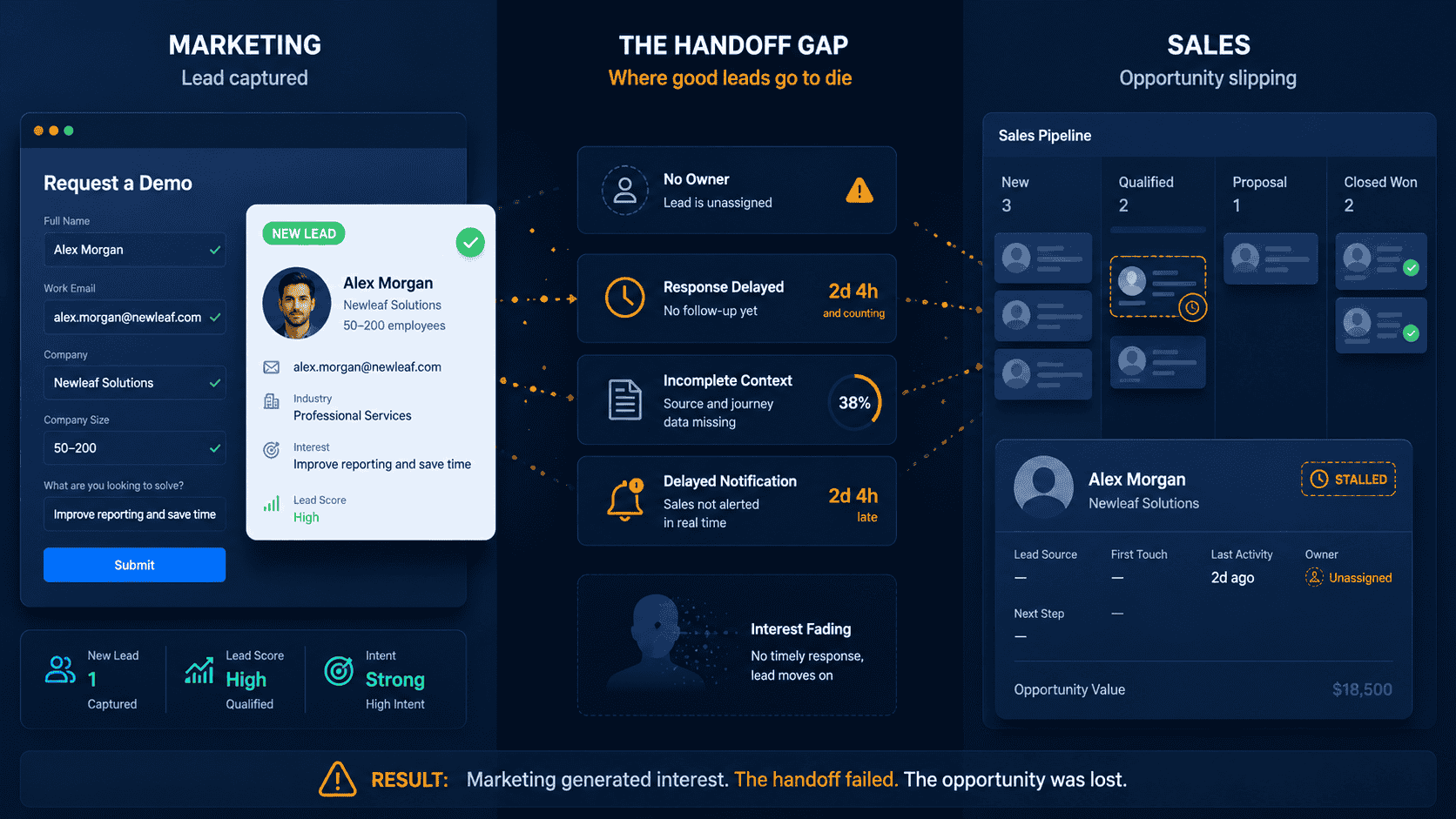
- A recorded conversion is not the same as a commercially tested sales opportunity.
- The handoff must transfer context, ownership, the required action, the response deadline, and the eventual outcome.
- Slow response, missing context, weak follow-up policy, and vague pipeline stages can make strong leads look unqualified.
- Management should audit complete lead histories before increasing acquisition spend or blaming lead quality.
- Technology helps only after the business defines qualification, ownership, response, escalation, recycling, and reporting rules.
Affiliate disclosure: Pulse & Prime is an independent HighLevel affiliate, not an employee or representative of HighLevel. We may earn a commission if you subscribe through links on this page, at no additional cost to you. Our analysis and opinions are our own.
A prospective customer sees an advertisement for a commercial cleaning service.
The offer addresses a real problem: the customer’s current contractor is unreliable, service complaints are increasing, and the company is preparing to move into a larger office.
The prospect visits the landing page, reads the service details, and submits a form requesting a quote.
Marketing records a conversion.
The campaign dashboard shows that the lead cost $74. Compared with other campaigns, that appears efficient.
An email notification is sent to a shared sales inbox. The message contains the prospect’s name, email address, phone number, and the words “Request a Quote.”
Nobody is formally assigned.
One salesperson assumes the office manager will distribute the inquiry. The office manager believes the sales team monitors the inbox. Another salesperson notices the lead the next afternoon, but the form does not show which advertisement the prospect saw, which service package was promoted, or what problem prompted the inquiry.
The salesperson makes one call. The prospect does not answer.
No voicemail is left. No follow-up task is created. The lead remains in the CRM under “New Inquiry” for three weeks before someone marks it lost.
Marketing concludes that the campaign generated a lead.
Sales concludes that the lead was poor.
Management increases the advertising budget because lead volume appears to be the only visible problem.
The prospect hires another provider.
Every department can argue that it performed its assigned task. The advertisement worked. The form worked. The notification was delivered. A salesperson attempted contact. The CRM contains a record.
The business still lost a legitimate opportunity.
This is not only a lead-generation failure. It is a failure of the operating system that should convert customer interest into sales action.
Why “Bad Leads” Becomes the Default Explanation
“Lead quality” is one of the easiest explanations for disappointing sales performance because it is difficult to disprove after the opportunity has disappeared.
Marketing points to clicks, form completions, cost per lead, audience targeting, and landing-page conversion rates. Sales points to unanswered calls, low urgency, limited budgets, and prospects who do not immediately agree to an appointment.
Both departments may be describing real evidence.
They may also be measuring different things.
Marketing frequently defines success as generating a response from someone who matches selected targeting or behavioral criteria. Sales often defines a useful lead as a person who can be reached, understands the offer, has a genuine commercial problem, has authority or influence, and is prepared to advance the conversation.
Those are not equivalent standards.
A form submission proves that someone took an action. It does not prove that the person is ready to buy.
However, the absence of a sale does not prove that the submission lacked value.
A lead can have strong customer fit but weak immediate readiness. The person may be researching options, preparing a budget, waiting for an existing contract to end, or collecting information for another decision-maker.
A lead can also have active intent but become unreachable because the company responded after the buying moment had moved on.
A salesperson may receive a qualified prospect but approach the conversation without the context that created the initial interest. The opening call then feels unrelated to the message that persuaded the prospect to submit the form.
The operational mistake is treating lead quality as one binary property:
Good lead or bad lead.
A more useful diagnosis separates five dimensions:
- Commercial fit: Does the customer’s company, problem, location, size, and likely value match what the business can serve profitably?
- Intent: Has the person expressed a real need, or merely engaged with content?
- Timing: Is the customer buying now, preparing to buy later, or only researching?
- Reachability: Can the business establish a meaningful conversation through the available contact information?
- Handling quality: Did the company respond with the right context, ownership, timing, and follow-up?
Sales may be correct that leads are genuinely poor when submissions come from excluded geographies, job seekers, students, existing vendors, fake accounts, incentive-driven forms, people outside the target market, or prospects whose needs the company cannot serve.
Marketing may be correct that commercially relevant prospects are being mishandled.
Management cannot resolve the disagreement using opinions. It must trace what happened after the lead entered the business.
Academic research has documented this conflict for years. A Journal of Marketing study described how sales representatives’ follow-up decisions are affected by lead prequalification, competing demands on their time, lead volume, managerial tracking, experience, and perceived quality. The finding matters because it shows that ignored leads are not explained only by laziness or attitude. Salespeople make rational allocation decisions inside the management system they have been given.
The Handoff Is Not a Moment—It Is an Operating System
Many companies believe a lead has been “handed to sales” when one of the following occurs:
- A notification email is sent.
- A new row appears in a spreadsheet.
- A contact record is created in the CRM.
- The salesperson is tagged in a message.
- A form submission enters a shared inbox.
These events transfer data.
They do not necessarily transfer responsibility.
A functioning marketing-to-sales handoff must transfer enough information and authority for a specific person to take a specific action within a specific period.
The complete journey is:
Lead captured → data recorded → context transferred → owner assigned → first response → qualification → next action → follow-up → pipeline movement → closed, lost, or recycled → outcome returned to marketing
A failure near the beginning changes everything that follows.
When campaign context is missing, the salesperson may not know what promise or problem started the conversation.
When ownership is missing, several people may assume someone else is responding.
When the expected first action is undefined, one representative sends an email while another calls twice and abandons the lead.
When the next step is optional, an opportunity can remain “open” without any scheduled action.
When lost reasons are vague, marketing cannot tell whether the audience was wrong, the offer was weak, the response was late, or the salesperson failed to make contact.
The business then optimizes advertising using incomplete outcome data.
The handoff should therefore include, at minimum:
- Reliable contact information
- Original lead source
- Campaign and offer
- Landing page or message seen
- Problem or intent expressed
- Relevant qualification answers
- Assigned owner
- Required response time
- Expected first action
- Follow-up standard
- Current pipeline state
- Required next action
- Method for returning the final outcome
The transfer is incomplete when any of these elements exists only in an employee’s inbox or memory.
Research on the marketing–sales interface describes integration as multidimensional, involving information sharing, structural connections, knowledge, authority, and differing departmental orientations. A 2022 synthesis covering 89 articles similarly found that the research remains fragmented because “alignment” is not one behavior or meeting—it is a collection of management mechanisms.
How the Failure Reinforces Itself
The largest problem is not any single broken stage. It is the feedback loop the stages create.
Marketing is measured on lead volume and cost per lead.
To improve those numbers, it reduces friction in the form, broadens targeting, or promotes a lower-commitment offer. Lead volume rises.
Sales receives more records but has limited time. Representatives prioritize referrals, repeat customers, personally sourced leads, and prospects that appear immediately valuable.
Marketing-generated leads receive inconsistent attention.
Because sales does not record detailed outcomes, marketing sees only that many leads failed to convert. It cannot determine whether the cause was targeting, timing, weak qualification, delayed contact, poor conversations, or insufficient follow-up.
Marketing then optimizes toward the metrics it can see: more form submissions at a lower cost.
Lead volume increases again.
Sales becomes more skeptical.
Good leads are mixed with weak ones, and the entire source is treated as untrustworthy.
The company has created a self-reinforcing revenue leakage loop:
Incomplete qualification produces sales distrust. Sales distrust reduces follow-up. Weak follow-up produces poor outcome data. Poor outcome data causes marketing to optimize for cheaper conversions. Cheaper conversions further reduce sales trust.
A study of sequential marketing and sales communication found that higher lead volume can harm downstream performance when sales capacity and follow-up timing do not expand with it. The implication is counterintuitive: a successful campaign can create worse commercial outcomes when it overloads an unchanged lead-management process.
Different Definitions of a Qualified Lead
Marketing-qualified leads and sales-qualified opportunities are useful concepts only when the company has defined the transition between them.
In many small businesses, the labels create more confidence than control.
Marketing may classify a lead as qualified because the person:
- Matches the target industry
- Downloaded a guide
- Submitted a quote request
- Selected a service
- Reached a scoring threshold
Sales may reject the same lead because the person:
- Is not ready to book immediately
- Has not confirmed budget
- Is not the final decision-maker
- Does not answer the first call
- Is comparing several providers
Neither department necessarily has the right definition.
The definition should reflect the economics and structure of the company’s sales process.
For a residential emergency service, a qualified lead may require immediate need, correct location, and phone availability.
For a consulting firm with a six-month sales cycle, a finance manager researching a future project may be commercially valuable even without an immediate buying date.
Management should define qualification using separate fields rather than one label:
- Fit: Can and should the company serve this customer?
- Need: Is there a problem the offer can plausibly solve?
- Intent: Has the person shown more than casual interest?
- Authority: Can the contact make or influence the decision?
- Timing: When could action realistically occur?
- Economic potential: Is the possible relationship worth the required sales effort?
Not every lead needs to satisfy all six before sales contact.
The purpose of the definition is to determine the appropriate treatment.
A high-fit, low-timing lead may enter a recycling or nurture process. A high-intent, low-fit lead should be disqualified quickly. A high-fit, high-intent lead should receive priority human attention.
A single “qualified” checkbox hides these distinctions.
No Clear Ownership Means No Reliable Response
Shared ownership sounds collaborative.
Operationally, it often means no ownership.
A shared inbox does not decide who should respond. A spreadsheet does not prevent two employees from contacting the same prospect. A CRM cannot create accountability when contacts remain unassigned.
Common ownership failures include:
- Leads are manually forwarded to representatives.
- Territory rules overlap.
- The person normally responsible is absent.
- Marketing assumes sales monitors the system.
- Sales assumes the office manager screens inquiries.
- Several branches receive the same notification.
- A lead is assigned to a team rather than a named person.
- Reassignment occurs without alerting the new owner.
- The manager cannot see unassigned records.
The financial consequence is not merely delay.
Unclear ownership produces four types of waste:
Waiting: The lead sits while employees decide who should act.
Duplication: More than one person contacts the prospect without coordination.
Reconstruction: Employees search messages and records to determine what has already occurred.
Abandonment: Everyone assumes the lead is being handled until it quietly ages out.
Every active lead should therefore have:
- One accountable owner
- One current status
- One required next action
- One deadline for that action
Other team members can participate. Accountability should remain singular.
The owner should also be visible to management. A process that assigns responsibility but does not expose overdue actions still depends on individual discipline.
Response Time Matters, but “Instant” Is Not the Same as Meaningful
A classic Harvard Business Review study found that companies frequently responded slowly—or not at all—to online inquiries, and that the likelihood of qualifying leads declined sharply as follow-up was delayed. The research is from 2011 and covered particular B2B and B2C environments, so its numerical findings should not be treated as a universal response-time law for every modern business. The durable management lesson is that customer intent is time-sensitive and response delay should be measured rather than assumed harmless.
Speed matters for several reasons.
The prospect may contact competitors.
The person may leave the buying task and return to normal work.
The urgency that motivated the form submission may fade.
The prospect may forget the details of the advertisement or offer.
A late salesperson is not entering the same conversation that existed at the moment of inquiry.
However, an automatic “Thanks, we received your message” email is not a meaningful sales response.
A useful first-response system has two layers:
Immediate acknowledgment
This confirms receipt, sets expectations, preserves momentum, and may provide the next step, such as appointment booking.
Accountable human action
A named employee reviews the context, determines priority, and continues the conversation appropriately.
The correct SLA depends on the buying situation.
An emergency contractor should not copy the same SLA used by a strategic consulting firm. A high-value demo request may deserve faster contact than a low-intent content download.
Management should measure its own response curve:
- How does contact success change by response interval?
- How does appointment conversion change?
- Which lead sources decay fastest?
- When does additional speed stop improving outcomes?
- Does the team sacrifice conversation quality to meet an arbitrary timer?
The answer should determine the response standard.
Sales Receives Data but Not Context
A salesperson may receive a valid name, phone number, and email address while still being unable to continue the conversation marketing began.
Imagine the prospect submitted a form after seeing an advertisement about:
Reducing missed calls for local service businesses.
The salesperson receives only:
New CRM inquiry.
The first call begins:
“Can you tell me what you’re looking for?”
From the prospect’s perspective, the company has forgotten the conversation that occurred on the landing page.
The lead expected continuity.
The salesperson restarted discovery from zero.
Context should include:
- The source and campaign
- The specific offer
- The page or content viewed
- Form answers
- Stated problem
- Service or product selected
- Location
- relevant company information
- Prior conversations
- Appointment activity
- Consent and channel preferences
This information does not eliminate discovery. It improves discovery.
The salesperson can begin with:
“You reached out after reviewing our missed-call follow-up service. You mentioned that inquiries are coming in after hours. I’d like to understand where those calls currently go and what happens the next morning.”
That opening shows the prospect that the company listened.
Context also changes prioritization. A repeat visitor who requested pricing should not necessarily be treated the same as a person who downloaded a general checklist.
Follow-Up Depends on Memory Instead of Policy
Many leads are not lost after the first response.
They are lost after the first unsuccessful attempt.
One salesperson makes a call and sends an email.
Another follows up six times.
A third decides that anyone who does not respond within two days is unqualified.
The CRM records activity but management has never defined what sufficient follow-up means.
A useful follow-up policy must answer:
- Which channels are appropriate?
- How many attempts are expected?
- Over what period?
- What changes when the prospect replies?
- When should automation stop?
- When does the owner escalate?
- When is the lead disqualified?
- When is the lead recycled for later contact?
- What evidence is required before marking it lost?
The policy should not force endless pursuit.
Some leads are unreachable, uninterested, unsuitable, or no longer active. Continued contact can waste sales capacity and damage customer experience.
The purpose is to replace arbitrary personal judgment with a controlled decision.
Every active opportunity should also have a next action.
“Proposal sent” is a historical fact.
“Call purchasing manager Thursday after internal review” is a next action.
Pipeline stages become dangerous when they describe where a deal appears to be without requiring evidence that a commercial event has occurred.
Disconnected Tools Fragment the Customer Journey
Separate tools are not automatically a problem.
A specialized CRM, calling platform, marketing automation tool, scheduling system, and analytics platform may be appropriate for a mature organization with reliable integrations, data governance, and clear ownership.
The problem begins when integration complexity exceeds the company’s ability to operate it.
A small team may unknowingly depend on a fragile chain:
- A form captures the lead.
- An integration sends it to a spreadsheet.
- Another automation creates a CRM contact.
- An email alert reaches a shared inbox.
- A calendar tool records the booking elsewhere.
- Text messages remain in a separate platform.
- Employees manually update pipeline stages.
- Marketing outcomes remain in the advertising dashboard.
Each component may work.
Management must still control:
- Duplicate records
- Failed integrations
- Inconsistent fields
- Missing source attribution
- Delayed synchronization
- Conflicting ownership
- Separate conversation histories
- Different definitions across systems
- Access and permission risks
- Reporting logic
The decision is not “one tool versus many tools.”
It is whether the company can reliably preserve the lead’s identity, context, owner, activity, and outcome across the chosen architecture.
A system with six well-integrated tools may outperform one broad platform configured poorly.
A single platform may be more economical for a small team when it removes handoffs the company cannot reliably manage.
Marketing Receives No Revenue Feedback
The marketing dashboard may report:
- Impressions
- Clicks
- Cost per click
- Form completions
- Conversion rate
- Cost per lead
These metrics explain how efficiently marketing generated recorded responses.
They do not explain whether those responses became:
- Meaningful conversations
- Qualified opportunities
- Appointments
- Proposals
- Customers
- Revenue
- Profitable revenue
Without downstream data, marketing cannot distinguish:
- A channel generating low-cost but irrelevant leads
- A channel generating valuable leads that sales ignores
- An offer attracting early-stage prospects who need nurturing
- A campaign reaching the right buyers with the wrong promise
- A representative whose follow-up performance is weak
- A territory with poor operational coverage
Closed-loop reporting should return at least:
- Contact status
- Qualification result
- Opportunity value
- Pipeline movement
- Appointment result
- Lost reason
- Revenue
- Sales-cycle length
- Representative
- Original source and campaign
Lost reasons must be specific enough to guide action.
“Not interested” is often an observation, not a diagnosis.
Better reasons include:
- Wrong geography
- Wrong company size
- Service mismatch
- No current project
- Budget unavailable
- Existing contract not ending yet
- Unable to contact after required cadence
- Competitor selected
- Price objection
- Poor sales experience
- Duplicate or existing customer
- Invalid submission
The business should also distinguish not now from not a fit.
A legitimate prospect with delayed timing should be recycled, not buried among rejected records.
Incentives Encourage Blame Instead of Diagnosis
Marketing and sales conflict is often described as a cultural problem.
It is usually a management-design problem first.
Marketing is rewarded for producing volume at an acceptable cost.
Sales is rewarded for closing revenue.
Given limited time, salespeople rationally prioritize opportunities that appear easier, larger, more familiar, or closer to purchase.
Marketing rationally optimizes toward metrics it can measure.
When management fails to create shared outcome metrics, both departments can perform well against their individual goals while company revenue underperforms.
A better measurement structure preserves functional accountability while connecting the functions.
Marketing should still own acquisition efficiency and audience quality.
Sales should still own conversations, qualification, progression, and closing.
Management should additionally track shared measures such as:
- Percentage of leads assigned
- Time to meaningful response
- Contact rate
- Qualified-opportunity rate by source
- Appointment rate
- Pipeline creation by campaign
- Revenue by source
- Lead-aging exceptions
- Percentage of outcomes returned to marketing
The point is not to create a complicated compensation system around every metric.
It is to make the entire revenue process visible enough that blame can be tested against evidence.
The Hidden Financial Cost
The most visible cost is wasted advertising spend.
The deeper cost is that the business pays for customer interest and then fails to give that interest a fair commercial test.
Consider an illustrative scenario.
A company generates 100 leads per month at an average acquisition cost of $80.
Total monthly lead-generation spend:
100 × $80 = $8,000
An audit finds that:
- 12 leads were never assigned
- 9 received no contact attempt
- 9 received one delayed attempt with no follow-up
Thirty leads therefore failed to receive the company’s defined minimum sales process.
The acquisition spend attached to those leads was:
30 × $80 = $2,400
This does not prove that $2,400 was completely wasted. Some leads may have been invalid or would never have purchased.
It does show that the business spent $2,400 generating responses that were never properly evaluated.
Additional costs may include:
- Sales time spent finding missing context
- Employees re-entering data
- Duplicate outreach
- Management disputes over lead quality
- Unreliable pipeline forecasts
- Budget shifted toward misleadingly cheap sources
- Higher customer-acquisition cost
- Missed repeat business
- Lost customer lifetime value
- Lost referrals
- Additional ad spending used to replace mishandled demand
The owner should treat unworked or poorly worked leads as a process cost, not simply a marketing statistic.
How an Owner Can Find the Real Leakage Point
Do not begin with a company-wide alignment meeting.
Begin with evidence.
Select a recent sample of 30–50 leads across several sources, representatives, and outcomes.
Reconstruct the complete record for each one.
First, test whether the lead was commercially plausible
Review the customer’s company, location, expressed need, service requested, role, and likely value.
This separates genuine targeting problems from downstream handling failures.
If most leads are visibly outside the target market, marketing has a qualification or targeting problem.
If many are plausible, continue the investigation.
Reconstruct the response timeline
For each lead, record:
- Submission time
- Assignment time
- First automated acknowledgment
- First human attempt
- First meaningful conversation
- Appointment time
- Follow-up attempts
- Last action
- Current status
Do not measure only the first email.
Measure the first meaningful attempt by an accountable owner.
Inspect context transfer
Could the salesperson see:
- Original source
- Campaign
- Offer
- Landing page
- Form answers
- Stated problem
- Relevant prior activity?
If not, the handoff transferred a contact, not a conversation.
Inspect ownership and next actions
Count:
- Leads never assigned
- Leads reassigned without action
- Active opportunities with no next step
- Records sitting too long in one stage
- Leads marked lost without a documented reason
A high number of unassigned leads indicates routing failure.
A high number of assigned but untouched leads indicates capacity, incentive, or accountability failure.
A high number of active records without next actions indicates pipeline-design failure.
Compare performance by source and representative
Suppose one campaign produces weak results across every representative. That supports a marketing or qualification diagnosis.
Suppose one campaign performs well with two representatives and poorly with another. The source may not be the primary problem.
Suppose conversion falls when response time exceeds one business day. That supports a staffing or SLA decision.
Suppose many leads become qualified but do not book appointments. The breakdown may be in the sales conversation, offer, pricing, or booking process.
The goal is to locate the first stage where commercially plausible leads stop progressing.
How to Repair the Marketing-to-Sales Handoff
A small company does not need a revenue-operations department to establish basic control.
It needs a written operating agreement that everyone can observe.
Define lead states jointly
Marketing and sales should agree on:
- What information makes a lead valid
- What makes it a priority
- What requires sales contact
- What should remain in nurture
- What should be disqualified
- What should be recycled
The definition should include fit, intent, timing, and value—not merely form completion.
Create a response agreement
The agreement should state:
- Who receives each lead type
- How assignment occurs
- Maximum time to first review
- Expected first action
- Required number or pattern of attempts
- What happens outside business hours
- What happens if the owner is unavailable
- When management is alerted
This is an operational SLA, not a motivational slogan.
Require source context
Every record should preserve enough information to continue the customer’s journey.
At minimum:
- Source
- Campaign
- Offer
- Form or page
- Stated need
- Qualification answers
- Consent and channel preference
Separate acknowledgment from selling
An immediate automated response can confirm receipt and offer a booking path.
A human owner should still review the lead, interpret the context, and determine the next action.
Define pipeline stages using evidence
A lead enters a stage only when a real event occurs.
For example:
- Contacted: A meaningful contact attempt was completed and recorded.
- Qualified: Fit and need were confirmed.
- Appointment booked: A specific appointment exists.
- Proposal sent: The actual proposal was delivered.
- Decision pending: The buyer has confirmed a decision process and date.
Each active stage should require a next action.
Establish follow-up, stop, and escalation rules
The process should determine:
- When follow-up continues
- When automation stops after a reply
- When the lead is reassigned
- When a manager is alerted
- When the lead is recycled
- When the record is closed
Return outcomes to marketing
Marketing should receive structured data on:
- Qualified opportunities
- Rejected leads
- Unreachable leads
- Lost reasons
- Sales value
- Revenue
- Time to conversion
The monthly review should focus on exceptions and patterns, not debating individual anecdotes.
What Technology Can and Cannot Fix
Lead-management technology can reduce administrative failure.
It can:
- Capture information consistently
- Preserve source fields
- Assign owners
- Send immediate acknowledgments
- Create tasks
- Record conversations
- Manage appointments
- Track pipeline movement
- Identify stalled opportunities
- Return outcome data
Research on lead-management systems suggests that technology can support sales performance through stronger follow-up intensity, adaptive selling, and better use of information—but performance depends on fit between the system, task, process, and salesperson capabilities.
More recent research on automated lead nurturing reached an equally important conclusion: the benefit is contingent rather than universal. Its effect varied according to factors such as sales-cycle length, expected sales volume, and the existing buyer–seller relationship. Businesses should therefore test whether automation improves their own process rather than accepting generalized software claims.
Technology cannot define a qualified opportunity for management.
It cannot repair weak targeting, an unclear offer, unrealistic pricing, poor sales conversations, conflicting incentives, or absent accountability.
It cannot force employees to update records correctly.
It cannot decide when a prospect needs empathy, negotiation, creativity, or executive attention.
Automating a broken process can make the same failure occur more consistently and at a larger scale.
When a Connected Platform Such as HighLevel May Help
A connected platform becomes relevant when the operating model is clear but the company cannot reliably execute it across disconnected forms, inboxes, calendars, messaging tools, spreadsheets, and CRM records.
HighLevel is one possible implementation option.
Its official documentation shows that form activity, appointments, opportunity changes, and stale opportunities can trigger workflows. Workflow actions can assign users, create tasks, send communications, and create or update opportunities. Opportunity records can contain a pipeline, stage, status, source, value, and assigned owner. HighLevel also supports settings that stop a workflow when a contact responds, helping prevent automated messages from continuing after a human conversation should take over.
A business might use those capabilities to test one controlled journey:
- Capture a lead from a real source.
- Preserve the campaign and form context.
- Assign a visible owner.
- Send an immediate acknowledgment.
- Create the required human task.
- Offer appointment booking.
- Move the opportunity through defined pipeline stages.
- Flag the opportunity if it becomes inactive.
- Stop routine automation when the prospect replies.
- Record the eventual outcome.
HighLevel may not be the right answer when the company already has a mature, integrated stack; when the primary problem is poor targeting or weak sales capability; when the team refuses to follow a defined process; or when migration and training costs exceed the expected benefit.
The platform should be evaluated against a specific operational failure, not against a long feature list.
Test the Handoff Before Buying More Leads
If your leads are currently divided across forms, inboxes, calendars, spreadsheets, and sales tools, use the extended HighLevel trial to test one real workflow.
Capture a genuine lead, preserve the source context, assign an owner, trigger the initial response, schedule the next action, and track the opportunity until it is qualified, lost, or recycled.
A Practical 30-Day Improvement Plan
Do not rebuild the entire sales operation in one project.
Fix one observable workflow.
Days 1–5: Establish the baseline
Audit 30–50 recent leads.
Measure:
- Commercial fit
- Assignment time
- Response time
- Contact success
- Follow-up attempts
- Next-action completion
- Stage movement
- Outcome
- Lost reason
- Revenue by source
Identify the first stage where plausible leads consistently stop progressing.
Days 6–10: Define ownership and rules
Write down:
- Qualification criteria
- Priority rules
- Assignment logic
- Response SLA
- First-action requirement
- Follow-up standard
- Stage definitions
- Lost reasons
- Recycling rules
- Escalation conditions
Name the owner of each part.
Marketing owns accurate source and context data.
Sales owns timely action, qualification, and outcome recording.
The sales manager or owner owns exceptions, aging, capacity, and accountability.
Days 11–17: Implement one real lead source
Choose one meaningful campaign, form, or inquiry channel.
Connect it to one lead-management workflow.
Do not import every historical contact or redesign every pipeline.
Test:
- Data completeness
- Duplicate handling
- Assignment
- Notifications
- Acknowledgment
- Human task creation
- Booking
- Reply behavior
- Stop conditions
Days 18–23: Train the responsible employees
Training should focus on operating decisions, not only software navigation.
Employees should know:
- What qualifies for priority treatment
- Where context appears
- What first action is required
- How to record contact
- How to set a next action
- When to stop automation
- When to recycle
- How to record a lost reason
Days 24–27: Review exceptions
Inspect:
- Unassigned leads
- Overdue first responses
- Opportunities without next actions
- Stale stages
- Duplicate records
- Leads receiving inappropriate messages
- Replies not handled by humans
- Outcomes missing from reports
Do not hide exceptions to make the new workflow look successful.
Exceptions reveal where the operating model is incomplete.
Days 28–30: Compare performance
Compare the pilot with the baseline:
- First meaningful response time
- Contact rate
- Qualification rate
- Appointment rate
- Opportunity creation
- Pipeline movement
- Percentage with a next action
- Lost-reason completeness
- Revenue-quality feedback returned to marketing
- Staff time spent reconstructing information
The result may show that the business needs better technology.
It may show that the existing tools are adequate but ownership was weak.
It may show that marketing is attracting the wrong audience.
It may show that sales capacity is insufficient.
The purpose of the 30-day project is not to validate a predetermined software purchase.
It is to identify the constraint that actually limits revenue.
Stop Buying More Leads Until You Know What Happens to the Ones You Have
More advertising can increase revenue when the customer journey works.
When the handoff is broken, more advertising increases the volume entering the same failure.
Before increasing spend, management should be able to explain:
- Who received each lead
- What context reached that person
- How quickly meaningful contact occurred
- What qualification decision was made
- What next action was scheduled
- How follow-up proceeded
- Why the opportunity was lost
- Whether a legitimate but early lead was recycled
- Whether the outcome returned to marketing
Marketing and sales alignment is not a recurring meeting.
It is not a shared dashboard.
It is not an agreement that both departments should communicate more.
It is an observable operating process with a chain of custody:
Information transfers. Ownership transfers. Action occurs. Outcomes return.
A business that cannot reconstruct that chain does not yet know whether it needs better leads.
It only knows that leads are disappearing.
Test One Complete Lead Journey
Before investing in another campaign, test whether one connected workflow improves the treatment of the demand you already generate.
Use a real source, a real owner, a real response standard, a defined pipeline, and a closed-loop outcome.
Use the 30-day trial to evaluate one controlled workflow before considering a broader migration. HighLevel does not guarantee leads, appointments, customers, or revenue. Results depend on targeting, the offer, implementation, sales execution, and team adoption.
This guide provides operational analysis rather than legal, privacy, or communications-compliance advice. HighLevel features, promotional eligibility, trial terms, pricing, billing, messaging charges, workflow capabilities, and Bootcamp availability can change. Confirm current details on the destination page and evaluate the consent, privacy, carrier, and data-handling requirements that apply to your business.