
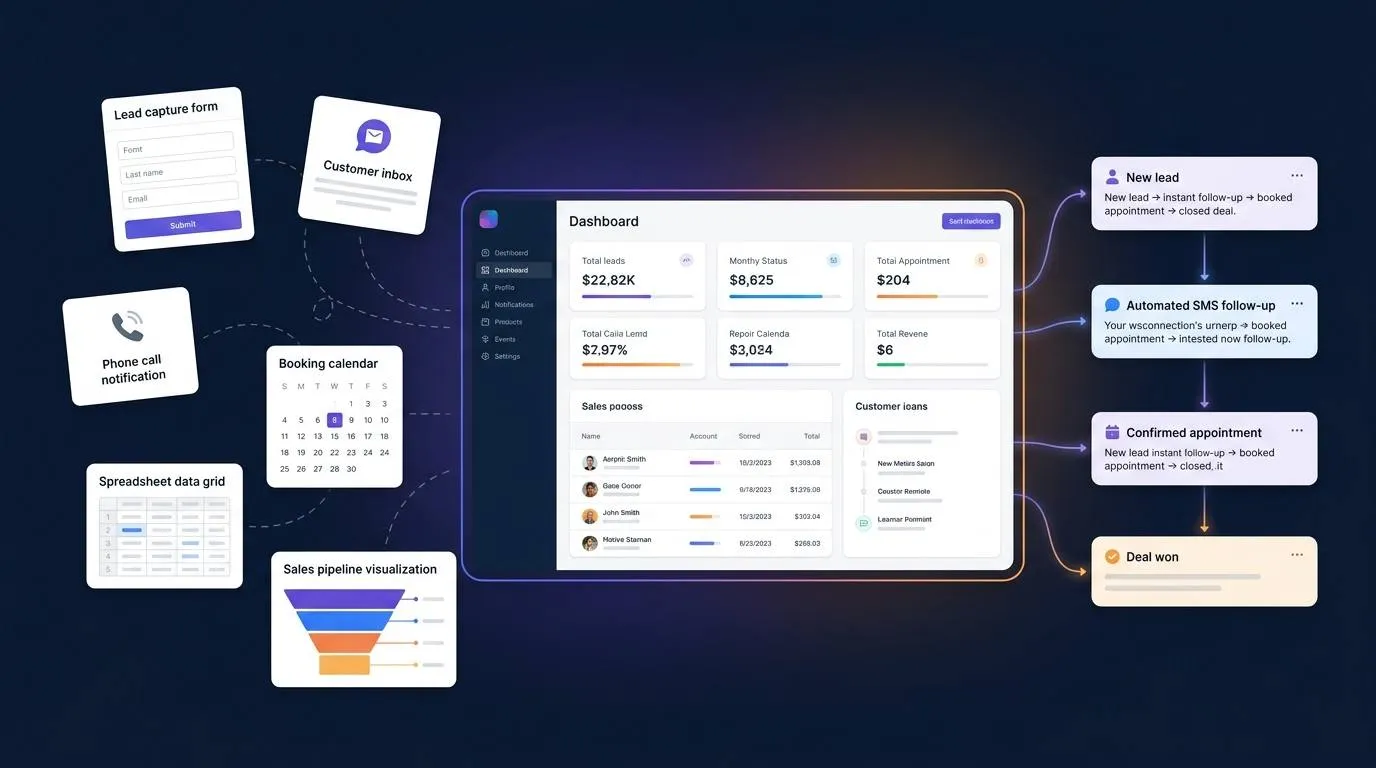
- Disconnected tools can work individually while the overall lead-management system still fails at the handoffs.
- The hidden cost includes delayed response, fragmented customer history, missed follow-up, unreliable pipeline data, and staff coordination time.
- HighLevel is most valuable when it connects a real customer journey rather than merely replacing a list of subscriptions.
- A 30-day test should begin with one lead source, one pipeline, one controlled workflow, and measurable operational outcomes.
- Pricing should be evaluated together with expected communication, AI, carrier, and optional usage charges.
Affiliate disclosure: Pulse & Prime is an independent HighLevel affiliate, not an employee or representative of HighLevel. We may earn a commission if you subscribe through links on this page, at no additional cost to you. Our analysis and opinions are our own.
Your business may already have a CRM, forms, email, text messaging, calendars, spreadsheets, and follow-up tools.
The problem is not necessarily that those tools are bad.
The problem is what happens between them.
A new lead enters through a form, but nobody responds until the following afternoon. A prospect calls outside business hours, but the missed call never creates a follow-up task. A conversation continues by text, while the CRM still shows the opportunity as untouched. An appointment is booked, but reminders are sent manually—or not at all.
Each failure looks small.
Together, they create slower response times, incomplete customer records, missed appointments, inconsistent follow-up, and sales opportunities that quietly disappear.
HighLevel brings lead capture, CRM, conversations, automated workflows, appointment booking, pipeline management, payments, reviews, and customer reactivation into one connected platform.
Less manual coordination. Faster follow-up. A clearer view of every opportunity.
The official Bootcamp promotion currently includes an extended 30-day HighLevel trial. Subscription billing begins after the trial unless canceled. Phone, SMS, email, AI, WhatsApp, and certain other services may involve usage-based or optional charges.
Your Tools May Be Working. But Your System Isn’t.
Most businesses do not intentionally build a complicated sales and marketing system.
It happens gradually.
A landing page builder is added to capture leads. A CRM is introduced when spreadsheets become difficult to manage. Another platform sends email. A separate service handles SMS. Appointments live in a calendar, while customer conversations remain split between personal inboxes, business phones, social messages, and internal notes.
Each tool may perform its own task correctly.
The overall system can still fail because nobody—or nothing—is reliably responsible for the handoff.
Consider what must happen after one prospect submits a form:
- The lead information must reach the correct system.
- The prospect should receive a timely acknowledgment.
- A team member must be assigned.
- The opportunity must enter the correct pipeline.
- Follow-up should continue if the prospect does not respond.
- Replies must remain visible to the person handling the sale.
- The prospect needs a clear path to book an appointment.
- The pipeline must reflect what actually happened.
When those steps depend on multiple tools, fragile integrations, manual data entry, and staff memory, the business does not have a reliable customer journey.
It has a collection of individual tasks that employees are expected to hold together.
The Hidden Cost Is Not Just More Subscriptions
Paying for several tools is easy to see.
The larger cost is often hidden in day-to-day operations.
Slow response while the lead is still deciding
A lead usually does not stop comparing options after submitting your form.
When the form notification sits in an inbox until someone checks it, the company is not simply responding late. It is allowing competitors to enter the conversation while the prospect’s interest is highest.
Customer history scattered across channels
One employee sees the email history. Another knows about the phone call. A third has the text conversation. The CRM contains only part of the story.
The next person who contacts the prospect must either reconstruct the conversation or risk asking questions the prospect has already answered.
Follow-up dependent on individual discipline
A good salesperson may remember to follow up.
A scalable business cannot design its process around the assumption that every employee will remember every lead, every promise, and every next action during a busy week.
Pipeline reports that do not reflect reality
A dashboard can look organized while the underlying data is outdated.
If employees must manually move every opportunity, the pipeline may reflect who updated the CRM—not what is genuinely happening in the market.
Management cannot see where leads are being lost
Campaign reports may show clicks and form submissions. The calendar shows appointments. The CRM shows deals.
But when those systems are separated, management may struggle to answer more important questions:
- How quickly did new leads receive a response?
- Which leads replied but were never called?
- Which campaigns created booked appointments?
- Which appointments became qualified opportunities?
- Which opportunities stopped moving because no next action was assigned?
- How many past customers could be reactivated?
HighLevel’s potential value is not simply reducing the number of browser tabs.
It is creating continuity between these events.
What a Connected Customer Journey Can Look Like
Imagine a prospect visits one of your landing pages at 8:47 p.m.
Instead of waiting for someone to check an inbox the next morning, the following process can begin automatically:
The lead enters one customer record
The form submission creates or updates the contact inside the CRM rather than leaving the information isolated inside a form tool or spreadsheet.
The prospect receives an immediate response
A confirmation can acknowledge the request, explain the next step, and provide a booking option while the prospect still remembers why they contacted the business.
The opportunity enters the correct pipeline
The lead can be assigned to a pipeline, stage, location, campaign, or team member based on the information submitted.
The team receives a task or notification
Automation does not have to replace the salesperson.
It can make sure the salesperson knows that a real lead requires attention.
Follow-up continues when the prospect does not respond
A defined sequence can send an appropriate email or SMS, create a call task, or wait for a reply without relying entirely on memory.
The prospect books an appointment
Available appointment times, confirmations, reminders, and booking activity remain connected to the same contact record.
The workflow changes when the customer acts
A reply, booked appointment, payment, completed form, or pipeline update can change what happens next.
This last point matters.
Good automation is not merely a timed series of messages. It responds to customer behavior and stops sending irrelevant follow-up when the situation changes.
HighLevel Is Most Valuable at the Handoffs
HighLevel includes a broad range of tools, but the strongest reason to evaluate it is not the length of its feature list.
The more useful question is:
Can the platform reduce the number of manual handoffs required to move a prospect from first contact to a real sales opportunity?
HighLevel can bring several parts of that process together:
| Disconnected process | Connected HighLevel workflow |
|---|---|
| Landing pages, forms, surveys, chat, and calls | Lead information enters a centralized contact record |
| Spreadsheet contacts and separate CRM records | Contacts and opportunities remain connected |
| Individual email and SMS tools | Conversations can be managed from a more unified view |
| Follow-up based on staff memory | Workflows trigger messages, tasks, assignments, and updates |
| Separate booking software | Calendars connect appointments to customer records |
| Manually updated deal trackers | Visual pipelines show opportunity stages and next actions |
| Separate review-request tools | Review requests can become part of the post-sale workflow |
| Old contacts left unused | Reactivation campaigns can re-engage previous leads and customers |
| Disconnected checkout and invoice links | Payments and invoices can connect with customer activity |
This does not mean HighLevel will replace every business system.
It is not a full accounting platform, ERP, inventory-management system, or advanced project-management solution.
A company may still need specialist software for finance, fulfillment, service delivery, inventory, reporting, or industry-specific operations.
The goal should not be to force every department into one application.
The goal should be to reduce the number of places where customer information and sales responsibility become disconnected.
What HighLevel Will Not Fix
HighLevel can make a defined process faster and more consistent.
It cannot create a strong process by itself.
It will not repair an unclear offer
If prospects do not understand what you sell, why it matters, or why they should choose you, automating the follow-up will not solve the underlying positioning problem.
It will not turn poor-quality traffic into qualified demand
A faster response to the wrong audience is still a response to the wrong audience.
It will not replace sales judgment
Some leads need a direct conversation, a customized proposal, reassurance, qualification, or a commercial decision that should not be delegated to software.
It will not automatically make the team use the CRM properly
If nobody owns lead response, pipeline accuracy, workflow maintenance, and exception handling, the company may recreate the same operational confusion inside a new platform.
It will not make excessive messaging acceptable
An automated message is still a business communication.
Email, SMS, calls, and other outreach must be configured thoughtfully and used in accordance with applicable consent, privacy, carrier, and communication requirements.
It will not prevent bad automation from scaling
A workflow can send the wrong message faster, follow up after the customer has already booked, contact someone too frequently, or continue messaging a lead who needs human attention.
HighLevel should therefore be treated as operating infrastructure.
It can execute the rules the business defines. Management still has to define good rules.
Is HighLevel Right for Your Business?
HighLevel is more likely to justify its cost when the business already has a functioning lead-generation and sales process—but execution is becoming difficult to coordinate.
HighLevel may be a strong fit when:
- Leads arrive from several sources.
- Response speed varies depending on who is available.
- Conversations are scattered across channels.
- Salespeople forget or delay follow-up.
- Appointments are central to the sales process.
- Management lacks reliable pipeline visibility.
- The team manually copies customer information between systems.
- The business wants to reactivate older leads or customers.
- An agency needs separate sub-accounts and repeatable client workflows.
- Several existing subscriptions overlap with HighLevel’s core capabilities.
HighLevel may not be the right next investment when:
- The business generates very few leads.
- There is no clearly defined offer.
- Most leads are unqualified.
- The sales process changes completely for every customer.
- Only a simple CRM or booking calendar is required.
- Current tools already work together reliably.
- Nobody can take ownership of setup and ongoing workflow improvement.
- The business mainly needs specialist accounting, ERP, inventory, or project-management software.
A broad platform creates value when consolidation reduces real operational friction.
It creates unnecessary cost when the business pays for capabilities it does not need or lacks the capacity to implement.
The Most Important Buying Question
Do not ask only:
“How many of our current tools could HighLevel replace?”
That question can encourage a rushed migration based on subscription cost alone.
Ask instead:
“Which customer handoffs are currently failing, and would connecting them improve response speed, appointment conversion, pipeline visibility, or staff workload?”
That is the economic case for the platform.
Replacing five tools is not automatically valuable if the new workflow is harder for the team to operate.
Replacing two tools may be highly valuable if it prevents qualified leads from being forgotten.
How to Evaluate HighLevel During the 30-Day Trial
Do not migrate your entire sales and marketing operation on the first day.
A large migration makes it difficult to distinguish product capability from setup problems.
Use the trial to test one complete workflow with real leads.
Step 1: Document the current process
Before configuring HighLevel, record how one lead currently moves through the business.
Measure:
- How the lead enters
- How long the first response takes
- Who owns follow-up
- Where conversations are stored
- How appointments are booked
- How opportunities are updated
- Where the process usually breaks
Without a baseline, the business may be impressed by the new interface without knowing whether performance improved.
Step 2: Choose one lead source
Connect one form, landing page, campaign, website, or other meaningful source.
Avoid importing every historical contact before confirming that the basic workflow is appropriate.
Step 3: Build one simple pipeline
Use only the stages required to manage the test.
For example:
New Lead → Contacted → Appointment Booked → Qualified → Won or Lost
A pipeline should represent real commercial decisions.
Adding more stages does not create more control if employees cannot distinguish between them.
Step 4: Configure the first response
Create an acknowledgment that confirms the inquiry and gives the prospect a useful next step.
The first message should not pretend to be a human conversation when it is automated.
Its purpose is to reduce uncertainty and maintain momentum until a team member can respond.
Step 5: Add a short follow-up workflow
Begin with a controlled sequence.
For example:
- Immediate acknowledgment
- Internal notification
- Follow-up task
- One or two relevant messages
- Exit when the prospect replies or books
Do not begin with a long campaign that contacts every lead repeatedly.
Step 6: Connect the booking process
Test:
- Calendar availability
- Confirmation messages
- Reminder timing
- Time-zone behavior
- Rescheduling
- Cancellation
- What happens after an appointment is booked
Experience the process as a prospect, not only as an administrator.
Step 7: Run real leads through the workflow
A workflow that works during an internal test may behave differently with:
- Duplicate contacts
- Incomplete phone numbers
- Existing customers
- Missed calls
- Replies outside business hours
- Canceled appointments
- Leads who use different communication channels
Use the trial to discover operational exceptions before migrating everything.
Step 8: Evaluate the result
At the end of the trial, compare the workflow with the previous process.
Ask:
- Did first-response time improve?
- Did more leads receive consistent follow-up?
- Did appointment booking become easier?
- Did no-show handling improve?
- Could staff see the full conversation more easily?
- Did pipeline data become more reliable?
- Was less information copied manually?
- Did the workflow reduce work—or create more administration?
- Could the team maintain the system after the initial setup?
The decision should not be based on whether HighLevel can technically perform a task.
It should be based on whether your business can operate that task better through HighLevel.
What Does HighLevel Cost?
HighLevel currently lists three primary monthly plans:
Starter — $97 per month
Designed for smaller businesses, solo marketers, or new agencies. It includes core platform features and up to three sub-accounts.
Unlimited — $297 per month
Designed for growing agencies that need unlimited sub-accounts, along with additional account-management and API capabilities.
Agency Pro — $497 per month
Designed primarily for agencies building a SaaS-style offering. It adds SaaS Mode, automated sub-account creation, advanced API access, and the ability to rebill certain services with a markup.
The normal HighLevel pricing page currently promotes a 14-day trial. The separate official HighLevel Bootcamp promotion provides an extended 30-day trial plus access to a live implementation session.
The monthly subscription is not necessarily the full operating cost.
Depending on how the account is configured and used, additional charges may apply for:
- Phone numbers
- Calls
- SMS and MMS
- Email sending
- A2P registration and carrier fees
- AI products
- Premium workflow features
- Optional add-ons or third-party services
Before deciding, estimate the cost based on expected usage rather than relying only on the advertised subscription price.
Frequently Asked Questions
Is HighLevel only for marketing agencies?
No.
Agencies are a major HighLevel audience because the platform supports multiple sub-accounts and reusable client systems. However, consultants, coaches, local service companies, small sales teams, and other businesses can also use its CRM, conversations, calendars, workflows, funnels, pipelines, and payment tools.
The more important question is whether the business has enough lead and customer activity to justify a platform of this scope.
Can HighLevel replace my entire technology stack?
Probably not—and it should not have to.
HighLevel may consolidate several sales and marketing tools, but specialist accounting, ERP, inventory, analytics, fulfillment, or project-management systems may still be necessary.
Evaluate the platform around the customer journey rather than trying to place every internal business process inside it.
Will HighLevel respond to every lead automatically?
It can trigger messages, tasks, assignments, pipeline updates, and other actions based on configured workflows.
But the business must decide:
- Which leads should receive automation
- Which message is appropriate
- When a team member should intervene
- What stops the workflow
- How replies and exceptions are handled
Automation supports response discipline. It does not replace ownership.
Is the trial really 30 days?
HighLevel’s standard pricing page currently advertises a 14-day trial.
The official HighLevel Bootcamp promotion provides an extended 30-day trial when signup is completed through the Bootcamp offer page.
What is included with the Bootcamp?
The official promotion currently advertises a live, guided HighLevel implementation session intended to help participants begin launching their account and workflow.
Available session times and the exact Bootcamp format may change, so review the current signup page before registering.
Will I be charged during the trial?
The HighLevel platform subscription is promoted as free during the 30-day trial period.
The account requires billing information and is expected to convert to a paid subscription after the trial unless canceled. Usage-based communication services and optional products may still generate charges.
Review the checkout terms and account usage before activating calls, messaging, email, AI, WhatsApp, or other paid services.
Can I cancel if HighLevel is not a good fit?
HighLevel states that accounts can be canceled through account settings. Review the current cancellation and billing terms during signup, and cancel before the trial ends if you do not want the paid subscription to begin.
Will HighLevel guarantee more leads or sales?
No.
HighLevel provides tools for capturing, organizing, following up with, and managing leads. Results still depend on traffic quality, the offer, messaging, sales execution, workflow design, team adoption, and customer demand.
Stop Letting Valuable Leads Disappear Between Tools
HighLevel is not valuable simply because it combines many features.
It becomes valuable when those features solve a real operational problem:
- Leads receive faster responses.
- Follow-up no longer depends entirely on memory.
- Conversations remain connected to customer records.
- Appointments trigger the right next steps.
- Sales opportunities have visible owners.
- Management can see where leads are moving—and where they are being lost.
Use the extended trial to test one complete journey:
Lead captured → immediate response → follow-up → appointment booked → opportunity tracked
If connecting that journey makes your business faster, more consistent, and easier to manage, HighLevel may deserve a permanent place in your sales and marketing stack.
If it adds complexity without improving execution, the 30-day test should help you discover that before making a long-term commitment.
The official Bootcamp promotion currently advertises a 30-day HighLevel trial and live implementation training. Billing information is required. The subscription renews after the trial unless canceled. Usage-based and optional charges may apply. Results are not guaranteed.
HighLevel pricing, promotional eligibility, trial duration, Bootcamp scheduling, billing terms, included features, and usage charges can change. Review the current destination page before subscribing. Email, SMS, calling, AI, WhatsApp, consent, privacy, and carrier requirements should also be evaluated for the countries and customers your business serves.