
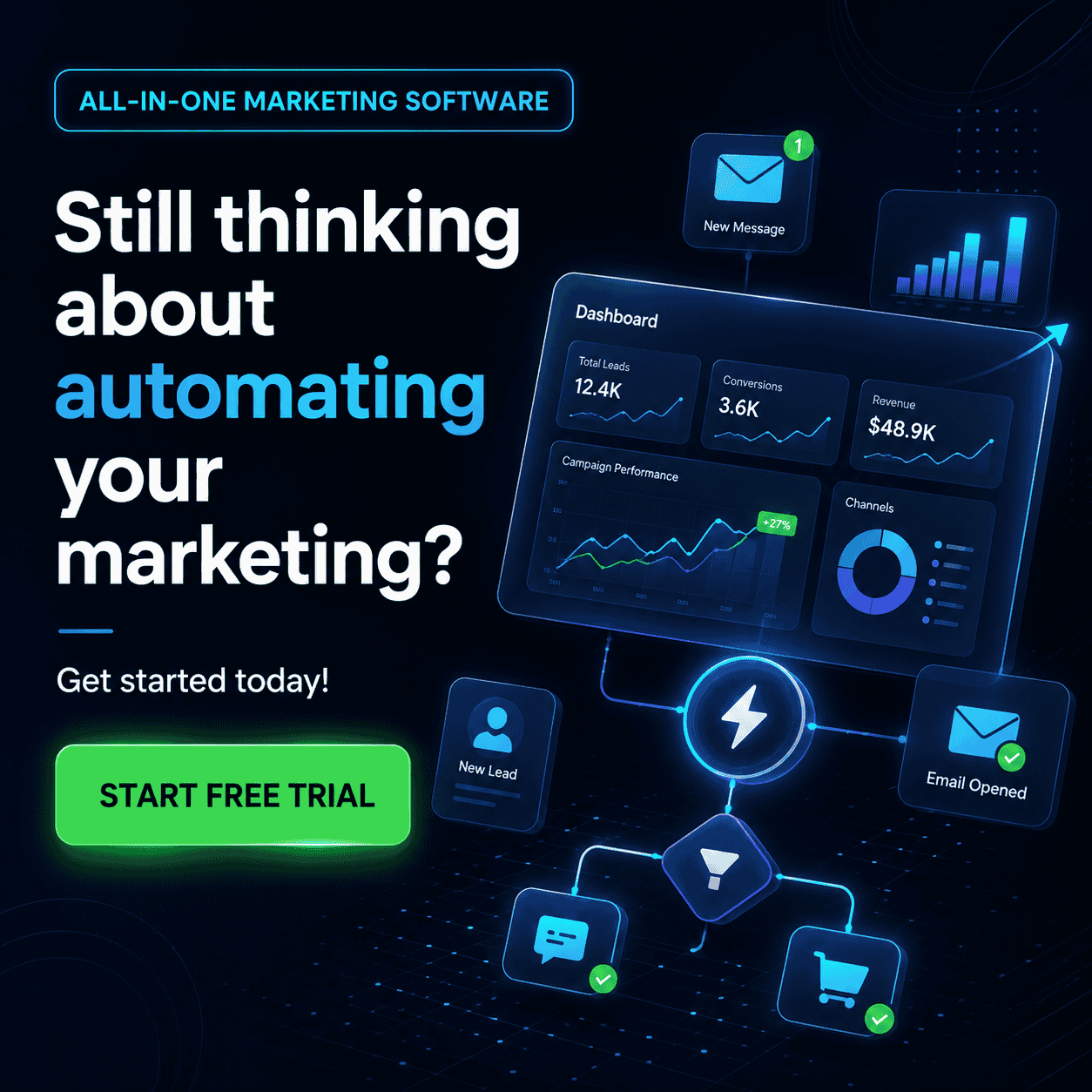
- HighLevel is designed to connect lead capture, communication, booking, follow-up, and pipeline management inside one operating environment.
- The value comes from reducing manual handoffs and lost context—not from accumulating the largest possible feature list.
- The platform cannot repair weak positioning, poor traffic quality, an unclear offer, or a sales process the team does not follow.
- A useful trial should test one complete customer journey rather than attempting a full migration on day one.
- Compare response time, follow-up coverage, appointments, pipeline visibility, manual work, and total software cost before committing.
Most businesses do not set out to build a complicated marketing system.
It usually happens one subscription at a time.
A landing page builder captures leads. Another platform sends email. A separate service handles SMS. Appointments live in a calendar, customer conversations remain scattered across inboxes, and sales opportunities are updated in a different CRM.
Each tool may work well on its own.
The problem appears between them.
A new lead submits a form, but no one follows up quickly enough. A prospect replies by text, but the sales pipeline is never updated. An appointment is booked, yet the right reminders are not sent. Management can see campaign clicks, but cannot clearly connect them to conversations, appointments, or real opportunities.
HighLevel brings the core parts of sales and marketing into one connected platform, helping businesses manage the customer journey from the first click through follow-up, booking, and pipeline management.
Rather than committing based on a long feature list, you can use the extended 30-day trial to test one real workflow inside your business.
Affiliate disclosure: Pulse & Prime is independent from HighLevel. We may earn a commission if you sign up through links on this page, at no additional cost to you. Our analysis and opinions remain our own.
Is Your Marketing Stack Creating More Work Than It Saves?
Using multiple marketing tools is not always a problem.
It becomes a problem when the business spends more time maintaining connections between tools than improving the customer journey itself.
Consider what happens after a lead submits a form.
The contact information may need to move into a CRM. Someone must assign the lead, send an acknowledgment, start the correct follow-up sequence, update the opportunity stage, and provide a way to book an appointment.
When those actions depend on separate platforms and manual handoffs, every step creates another opportunity for delay or lost information.
The real cost is not limited to software subscriptions.
It also includes:
- Leads that receive slow or inconsistent follow-up
- Customer conversations scattered across multiple channels
- Salespeople working from incomplete contact histories
- Appointments missed because reminders were not connected
- Opportunities left in the wrong pipeline stage
- Staff time spent copying data between systems
- Reporting that measures activity without showing what produced revenue
An all-in-one platform is designed to reduce this operational friction by keeping more of the workflow inside one connected environment.
What HighLevel Brings Together
HighLevel combines several functions that businesses often manage through separate tools.
Lead capture
Build websites, landing pages, funnels, forms, surveys, and chat experiences that move new contacts directly into the system.
Contact and pipeline management
Store customer information, organize opportunities, assign leads, and track where each prospect stands in the sales process.
Multichannel communication
Manage email, SMS, calls, and other customer conversations from a more centralized workflow.
Automated follow-up
Create workflows that send responses, assign tasks, update pipeline stages, deliver reminders, and continue nurturing leads when immediate human contact is not possible.
Appointment scheduling
Connect calendars and booking pages so prospects can move from interest to a scheduled conversation with fewer manual steps.
Reporting and visibility
Track what happens after a lead enters the system instead of measuring only clicks, form submissions, or isolated campaign activity.
The main value is not the number of features.
It is the ability to connect those features into one practical customer journey.
For example, a prospect can submit a form, receive an immediate response, enter the appropriate pipeline, be assigned to a team member, receive follow-up messages, and book an appointment without employees manually transferring information between several systems.
Built for More Than Marketing Agencies
HighLevel is widely associated with marketing agencies, but its underlying tools may also suit businesses that manage their own lead generation and sales follow-up.
It may be relevant for:
- Small and midsized businesses running their own marketing
- Local service businesses that depend on calls, forms, and appointments
- Consultants, coaches, and freelancers selling through booked conversations
- Sales teams that need stronger pipeline visibility
- Marketing teams managing funnels, email, SMS, and lead nurturing
- Agencies creating repeatable systems for multiple clients
The platform is most useful when a business already has enough marketing activity that disconnected systems are becoming difficult to operate.
A very small business that only needs basic contact storage, occasional email campaigns, or a simple booking calendar may not need a platform this broad.
What HighLevel Will Not Fix Automatically
HighLevel can connect tools and automate repeated actions.
It cannot repair every sales or marketing problem.
The platform will not automatically:
- Make an unclear offer compelling
- Turn irrelevant traffic into qualified leads
- Replace effective sales conversations
- Fix weak positioning
- Create a follow-up strategy without business input
- Prevent poorly designed automation from frustrating customers
- Make employees use a process they have not agreed to follow
Software can make a good process faster and more consistent.
It can also make a poorly designed process produce mistakes at greater scale.
Before building automations, the business still needs to decide:
- How leads should be categorized
- Which leads deserve immediate human contact
- Who owns each opportunity
- When email or SMS follow-up should begin
- What messages should be sent
- When an automated sequence should stop
- When a team member should take over
- How consent and communication requirements will be handled
HighLevel is better viewed as infrastructure for an existing sales and marketing strategy—not a substitute for one.
How to Test HighLevel During the 30-Day Trial
Do not try to rebuild your entire marketing operation on the first day.
That usually creates unnecessary complexity and makes the platform harder to evaluate.
Instead, test one complete customer journey.
Step 1: Choose one lead source
Build one landing page or connect one existing form, campaign, or website lead source.
Avoid importing every contact and campaign before confirming that the basic workflow works.
Step 2: Create one simple pipeline
Define the few stages that matter for the test, such as:
- New lead
- Contacted
- Appointment booked
- Qualified opportunity
- Won or lost
The pipeline should reflect how your team actually sells, not how a software template assumes it sells.
Step 3: Build a short follow-up workflow
Create an immediate acknowledgment followed by a small number of useful follow-up messages.
The goal is not to send as many messages as possible.
The goal is to prevent legitimate leads from being forgotten while giving interested prospects a clear next step.
Step 4: Connect a booking calendar
Allow qualified prospects to schedule a conversation without unnecessary email exchanges.
Test the confirmation and reminder process from the customer’s perspective.
Step 5: Assign a real owner
Make sure every lead has a person responsible for reviewing replies, handling exceptions, and moving the opportunity forward.
Automation should support ownership, not hide the absence of it.
Step 6: Measure the operational result
During the trial, compare the new workflow with your current process.
Examine:
- Lead response time
- Percentage of leads receiving follow-up
- Appointments booked
- Missed appointments
- Pipeline visibility
- Manual data entry
- Staff workload
- Customer replies
- Opportunities that previously would have been lost
At the end of the trial, ask:
Does connecting these activities make our sales and marketing process easier to operate, easier to measure, and less dependent on manual handoffs?
If the answer is yes, HighLevel may be able to replace or consolidate parts of your current marketing stack.
If the business still lacks qualified traffic, a clear offer, effective messaging, or a defined sales process, those problems should be addressed before adding more automation.
When HighLevel May Be Worth Evaluating
HighLevel may be a strong candidate when:
- Your business uses separate tools for funnels, CRM, email, SMS, calendars, and follow-up
- Leads are being lost between systems
- Response times depend on employees manually checking forms or inboxes
- Customer conversations are difficult to track
- Sales opportunities are not updated consistently
- Appointment booking and reminders are disconnected
- Management cannot clearly see what happens after lead capture
- Your team wants to test a more connected workflow before consolidating tools
It may be less suitable when:
- You only need one or two basic marketing functions
- Your team does not have time to configure and maintain workflows
- Your lead volume is too low to justify a broader platform
- Your main problem is traffic quality, positioning, or the offer itself
- Your current tools already work together reliably
See Whether One Connected Platform Fits Your Business
HighLevel should not be judged by how many features appear on its website.
It should be judged by whether it improves a real business process.
Use the 30-day trial to test one complete workflow:
Lead captured → immediate response → follow-up → appointment booked → opportunity tracked
If the platform makes that journey faster, more visible, and easier for your team to manage, it may deserve a permanent place in your marketing stack.
If it adds complexity without improving execution, you can make that decision before committing long term.
Extended 30-day trial eligibility, plan availability, pricing, and billing terms are determined by the promotional signup page. Review the current offer details before creating an account.
This guide provides general marketing and software information and is not a hands-on product review. HighLevel features, promotional eligibility, plan availability, pricing, billing terms, messaging requirements, and integrations can change. Confirm the current terms on the destination page before subscribing, and ensure that email, SMS, calling, consent, and data-handling workflows comply with the rules that apply to your business and customers.